



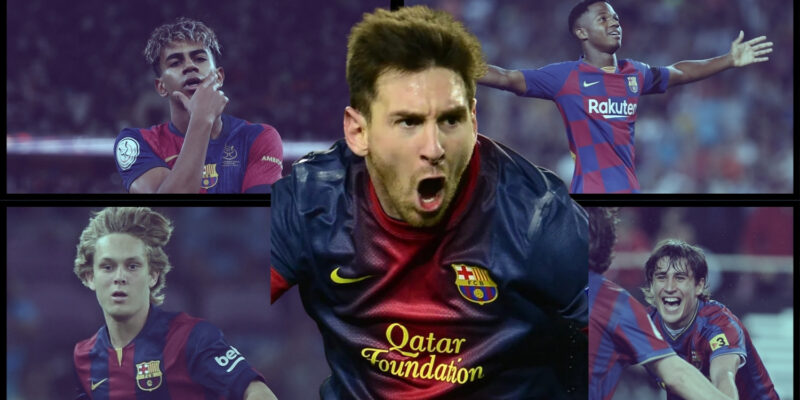
Being labeled “the next Messi” is often considered a curse disguised as praise. Scouts and journalists tend to assign this nickname to any teenager who displays dazzling dribbling skills or has a remarkable left foot, hoping to witness lightning strike twice.
However, this tag can be a poisoned chalice; it subjects the teenager to immense pressure and inflates expectations far beyond what is realistic.
Many of these promising players eventually fade from the global spotlight due to injuries, inconsistencies, or simply the overwhelming nature of the hype. Their stories highlight just how rare Messi’s greatness truly is.
Interestingly, Messi himself once faced the burden of a legacy label when he was referred to as “the New Maradona” during his youth. By the time he led Argentina to victory in the World Cup in 2022, he had not only lived up to that label but arguably surpassed Maradona’s legacy.
In a spirit of irony, here are 15 players who have carried the Next Messi tag and how their careers turned out.
15. Ryo Miyaichi (Japanese Messi)

One of the most common cases of a flash-in-the-pan prospect is Ryo Miyaichi, who joined Arsenal in 2011. The British tabloids quickly dubbed him a Messi regen, fueling high expectations for his dribbling skills and talent.
However, the harsh reality of European football, along with persistent injuries, quickly set in. Miyaichi made only one appearance for Arsenal’s first team, spending most of his time on loan at Feyenoord, Bolton Wanderers, and Hamburger SV.
He was unable to establish himself at the top level as a certified starter. After the initial hype faded, Miyaichi returned to Japan in 2020 to play for Yokohama FC, basically ending any hopes of blossoming into the Japanese Messi.
14. Marko Marin (German Messi)

In 2012, Marko Marin was the German Messi, even with Mario Gotze already lighting up the league.
After making a significant impact in the Bundesliga with Werder Bremen, Chelsea acquired him for a substantial fee. However, his time at Stamford Bridge proved disastrous. Marin failed to secure a regular spot in the team, making only six appearances in the Premier League.
He subsequently went on four different loan spells over four seasons to Sevilla, Fiorentina, Anderlecht, and Mainz, but never managed to find consistency. His potential fizzled out as he struggled to adapt to different playing styles.
Eventually, the German Messi drifted through leagues in Greece, Spain, and Hungary before retiring quietly in 2023.
13. Patrick Roberts (English Messi)

In 2015, Manchester City made headlines by signing 19-year-old Patrick Roberts, a talented, dribbling winger from Fulham’s academy. The English media were quick to start mentioning his name alongside that of Leo Messi.
The hype surrounding him was immense, with even Lionel Messi reportedly supporting the young player’s potential.
However, Roberts struggled to establish himself at City. While his loan spell at Celtic marked his most successful period—where he won seven trophies—injuries continually hindered his progress.
By 2020, he found himself on a series of loans to Girona, Norwich, and Middlesbrough without leaving any memorable impact.
Today, the English Messi is playing in the EFL Championship with Birmingham, on loan from Sunderland.
12. Alen Halilović (Croatian Messi)

As a Croatian teenager, Alen Halilović was often viewed as an ideal candidate for the title of “next Messi.” He had the dribbling skills, vision, and even a physical resemblance (small frame and left-footed).
Amid the frenzy of excitement, he joined Barcelona at just 17 years old. However, while at Camp Nou, he remained in Messi’s shadow and never played a competitive minute for the first team.
After two years, he left Barça and began a challenging cycle of moving between clubs, including Hamburg, Las Palmas, Sporting Gijón (on loan), and AC Milan (on loan). Each stop was largely underwhelming, marked by modest statistics and a lack of sustained success.
By his mid-20s, the initial hype had faded, leaving him with a journeyman’s career. The Croatian Messi currently plays for mid-table teams in the Balkans.
11. Iker Muniain (Spanish Messi)

Iker Muniain burst onto the scene as Athletic Bilbao’s teenage phenom after making his debut at age 16. For a time, he seemed unstoppable—and all the initial comparisons with Messi seemed plausible.
Crucially, however, Muniain never left the Basque Country; he became a loyal one-club player, accumulating nearly 400 appearances and leading Athletic Bilbao to sustained success.
While Muniain had a remarkable career, he never reached the heights of Messi. In a way, he avoided the worst pitfalls of fame by staying loyal to his club and remaining somewhat under the global radar.
10. Giovani dos Santos (Mexican Messi)

Giovani dos Santos emerged from the famous La Masia academy and was initially seen as a creative whirlwind. Technically superb, he had already led Mexico to major youth titles. His highlights at the youth level were dazzling, but at the senior level, he never quite found his rhythm.
A move to Tottenham Hotspur in 2008 was underwhelming, and after playing for various clubs, including Villarreal and LA Galaxy, Dos Santos struggled to nail down a spot at these teams.
Injuries and crushing inconsistency plagued him throughout his career, and he admitted that the pressure of constant comparisons weighed heavily on him. He has been immense in the MLS, but he never lived up to the initial expectations of becoming the Mexican Messi.
9. Munir El Haddadi (Moroccan Messi)

Munir El Haddadi was another La Masia graduate who seemed destined for superstardom. He even scored on his La Liga debut for Barcelona at age 18. There was great buzz around him, and many believed he might carry the club’s legacy forward thanks to his incredible promise.
However, Munir faced the harsh reality of competing with the legendary MSN front line (Messi, Suárez, Neymar), which limited his playing time and forced him into a series of loans.
After earning a solitary, 13-minute senior cap for Spain in 2014, his international career effectively ended, leading him to switch allegiance to Morocco after years of legal battles and a FIFA rule change.
At the club level, Munir played for Sevilla and Getafe before arriving at UD Las Palmas. While his skill was never in question, he struggled to maintain the momentum of his debut season.
8. Arda Güler (Turkish Messi)

The latest addition to the cycle of overwhelming expectations is Turkish sensation Arda Güler. His impressive ball skills and vision have created immense hype surrounding his potential, with one youth coach even declaring, “If we talk about potential… Arda has more potential than Messi.”
This extreme hype coincided with his 2023 transfer from Fenerbahçe to Real Madrid. At just 20 years old, Güler is still adapting to the elite level of football.
The lesson from his story isn’t a fall from grace but rather the preemptive burden placed on him: he has been labeled before even having a chance to succeed. He is similar to a young Özil or Modrić.
Despite a slow start at Real Madrid, Arda Guler has slowly made his way into the starting spot. His partnership with Kylian Mbappe seems to have caught the favour of Xabi Alonso.
And if he intends to become an icon in Madrid, he needs to get rid of that Turkish Messi tag right away.
7. Xavi Simons

Born in the Netherlands and a former La Masia starlet, Simons was once widely regarded as the only youth player at the Barcelona academy dubbed “the next Messi.”
However, he struggled to make an impact at both Barcelona and Paris Saint-Germain, which resulted in a period of instability.
Despite being young, he has been on loan at clubs like PSV Eindhoven and RB Leipzig, but he finally found a home at Tottenham after joining them in the summer of 2025.
Unlike some others on this list, Simons is still young and showing clear improvement; he hasn’t faded into obscurity, but his path has been slower and less direct.
Ironically, the lofty expectations of Messi-like greatness have shifted to more modest but still impressive comparisons, such as the “new Iniesta.” The jury is still out on Simons, but for the moment, all the rumblings of being the Dutch Messi have faded into silence.
6. Ansu Fati

During the 2019-20 season, the teenage winger made a remarkable debut for the Barcelona first team.
He instantly broke multiple records as the club’s youngest goal-scorer and the youngest scorer in the Champions League.
The media hype surrounding him was immense, positioning him as the rightful successor to Lionel Messi. This expectation was solidified when Fati received the iconic number 10 jersey following Messi’s departure in 2021.
Unfortunately, disaster struck in late 2020 when he suffered a horrific knee injury, specifically a torn meniscus. His recovery was grueling, requiring four painful surgeries and sidelining him for almost an entire year.
When he finally returned, the explosive acceleration and fearless movement that characterized his play were no longer there. The injury had robbed him of the sharpness essential for elite-level wing play, resulting in tentative movements, hesitation, and a significant loss of confidence.
Despite the guidance of coach Xavi, Fati could never regain his early form and was eventually loaned out to Brighton & Hove Albion in a high-profile move intended to revitalize his career. However, this stint produced only four goals in 30 disappointing appearances.
Now that he’s in Monaco, the hope is that Ansu Fati can even regain his confidence as a top prospect.
5. Gerard Deulofeu

Gerard Deulofeu is another example of a promising talent from La Masia who faced immense expectations.
Known for his speed and technical skill, he drew early and harsh comparisons to Messi thanks to his electrifying right-footed dribbles and low center of gravity—traits reminiscent of the legendary Argentine’s playing style.
Early on, pundits hailed him as Messi’s true heir, and he even earned a senior cap for Spain as a teenager.
However, Deulofeu quickly proved to be inconsistent. While he exhibited raw talent, he often lacked the tactical discipline and clinical decision-making required at the highest level, leading to moments of brilliance interspersed with frustrating errors.
After a handful of appearances for the Barça first team, he was sold to Everton and subsequently passed through various loans and transfers, including spells at AC Milan and Watford.
Notably, he was briefly re-signed by Barcelona under coach Ernesto Valverde in an attempt to integrate the ‘heir’ into the squad. But this effort also fell short after just a few games, closing the door on the succession plan.
While he produced some magical moments—including a memorable run to an FA Cup Final with Watford—he never achieved the sustained elite performance necessary to fulfill the expectations.
Worst of all, Deulofeu openly acknowledged the debilitating weight of these comparisons. He stated on Spanish television, “When you’re young at Barça… many people think you will be the next Messi… they create a dream for you that is very difficult to reach.”
4. Martin Ødegaard (Norwegian Messi)

The turbulent career of Martin Ødegaard offers a powerful lesson in how institutional mismanagement, driven by unrealistic hype, can delay the emergence of a superstar.
At just 15 years old, Ødegaard became the subject of a global bidding war and was hailed as “the Norwegian Messi” for his silky touch, impressive left-foot skills, and exceptional vision.
His signing with Real Madrid in 2015 from Strømsgodset was seen as a significant achievement, but the pressure that accompanied this move proved overwhelming.
Real Madrid’s management placed the teenager in an unsustainable environment, forcing him to train with the first team while playing for the reserves, which greatly hampered his natural development.
Instead of a steady rise, Ødegaard was sent on a lengthy carousel of loans to clubs such as Heerenveen, Vitesse, and Real Sociedad, disrupting his continuity and focus. It wasn’t until his final loan spell at Arsenal that he found the stability, trust, and system that suited his playmaking style.
His permanent transfer to Arsenal in 2021 marked a much-needed reset for his career. Shedding the unrealistic expectations from his time at Madrid, Ødegaard blossomed into a solid, world-class playmaker and club captain.
While he has fulfilled his potential as an elite European player, the lofty comparisons to Messi have faded.
3. Paulo Dybala

Argentina, always in search of the next footballing deity, produced another prodigious talent in Paulo Dybala. His style of play—characterized by technical brilliance, a powerful left foot, and a tendency to cut in from the right—made comparisons to Messi inevitable.
Early in his career, especially during his explosive start at Palermo and later at Juventus, media outlets frequently positioned him as one of Messi’s potential successors.
However, Dybala possessed a crucial self-awareness that many others on this list lacked. He actively sought to dispel these impossible expectations with a public statement in 2017: “I don’t want to be the new Messi… there is only one Messi.”
This conscious refusal to accept the burden of the “Next Messi” label became key to his professional longevity and success, transforming his story into the ultimate antidote for the curse.
Instead of trying to replicate perfection, Dybala focused on maximizing his own unique talent, earning the cherished Italian nickname, La Joya (The Jewel).
At Juventus, he flourished and became a talismanic figure, securing five consecutive Serie A titles. His success stemmed from consistent goal contributions, free-kick expertise, and versatility, rather than pursuing an unattainable benchmark.
Even after his high-profile and emotional move to AS Roma in 2022, Dybala continues to perform at an elite, match-winning level, validating his early decision to define his own path.
By rejecting the impossible label and focusing on his own impressive game—which may not rival the status of the greatest of all time—he has forged a remarkable and highly decorated career.
2. Bojan Krkić (Mini-Messi)

If there is one definitive example of the psychological challenges faced by young football prodigies, it is Bojan Krkić.
Born in 1990, Bojan was the original sensation who made his debut for the Barcelona first team at just 17 years old, breaking Messi’s record as the youngest-ever La Liga player. With his dazzling technique and impressive first touch, Camp Nou embraced him as “Mini-Messi.” Initially, he appeared unstoppable.
However, while Messi went on to win eight Ballon d’Or awards, Bojan found himself caught in a relentless cycle of transfers and loan spells at major clubs like AC Milan and Roma before landing famously at Stoke City in the Premier League. His five years at Stoke felt like a cruel parody of the global success that was once promised to him.
Bojan’s story is both tragic and instructive. His journey from La Masia wunderkind to MLS journeyman (he finished his career with Montreal Impact) exemplifies the “curse” faced by young talents.
Although he showed flashes of brilliance—earning one cap for Spain and scoring over 100 career goals for smaller clubs—he never achieved global stardom.
Bojan later admitted that the constant comparisons to Messi drove him to frustration, as he felt like a cartoon version of Messi’s story rather than a person in his own right.
‘I had anxiety attacks, but no one wants to talk about that. Football’s not interesting.’
His struggle to mentally and physically sustain the role assigned to him underlines the immense pressure that ultimately derailed his undeniable talent.
1. Lamine Yamal (Messi 2.0)

If anyone currently embodies the hope of becoming the “Next Messi”, it is Lamine Yamal. He is the one touched by Messi himself.
The young Barcelona winger’s trajectory has been remarkable since his debut in 2023. As a left-footed La Masia graduate with an incredibly low center of gravity and explosive speed, the comparisons to Messi were immediate and inescapable.
However, for the first time, a player is actively living up to the formidable expectations.
During his first full season, Yamal set numerous age-related records at both club and international levels, including becoming the youngest starter and goal-scorer in La Liga, as well as the youngest player and scorer in the history of the Spain national team.
This culminated in an outstanding performance at Euro 2024, where he became the youngest-ever scorer in a major international tournament during the semi-finals.
His composure under the intense media spotlight—often demonstrating maturity while discussing pressure—suggests a mental fortitude that was lacking in his predecessors.
While he is still too young to be declared a guaranteed superstar—the physical demands of a long career may still challenge him—Yamal stands out as the only “Next Messi” candidate currently not just surviving, but thriving.
He is the first player to enter this succession narrative and make the comparison feel justified based on performance rather than mere potential, providing genuine hopes that the curse might finally be broken.
Unfortunately, Barcelona has not learned from the Ansu Fati situation, making Yamal play every minute for both the club and the Spain National team.
Since the start of the 2025/2026 season, he has been in and out of the team with recurring injuries. His lifestyle off the pitch is not helping either, having been involved in a controversy surrounding his 18th birthday.
Who wrote this?

Hashim Kolawole is a big sports fan who turned his love for the game into a career in sports writing. For him, writing is a way to share his passion for sports with the world.
Hashim also enjoys telling stories about football, basketball, and other sports. He loves reading, traveling, listening to afrobeat and a little bit of hip hop. He is also a chronic candy crush addict.