


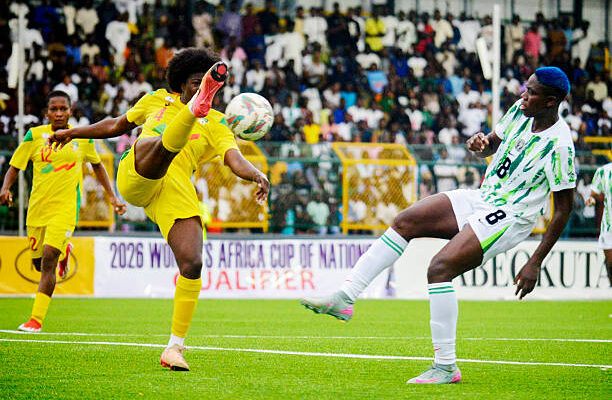
Banners, scattered waves of the green-white-green flag, a huge crop of sport creators and journalists with cameras and phones, and the unmatched ambience of fervent spectators blowing vuvuzelas; these were the scenes that awaited me when I arrived at the 10,000-capacity MKO Abiola sports complex for the match between Nigeria and Benin at the 2026 WAFCON Qualifier.
Honestly, if someone had walked into that stadium without context, they could’ve easily mistaken it for another men’s game.
And that, in itself, proves a vital point in the Nigerian sporting ecosystem.
I suffered a slight hustle while trying to secure a spot in the media section of the stadium. But in the end, I settled in quite well — thanks to my experience in covering NPFL matches.
When the Stadium Transformed

Around 3:45 pm, the players headed back to the dressing rooms. By the time they returned to the pitch and the referee blew the whistle, the stadium was already full. Even with that, more fans were still streaming in to catch a glimpse of the Super Falcons.
Where I stood, there was a nursing mother with a baby strapped to her back as she made her way to the last empty seat just behind the media section. A group of boys still in their school uniforms, squeezing through the shoulders of men twice their height. Clusters of women in matching Ankara outfits at the opposite end of the stadium, providing the familiar rhythm and ambience typical of Nigerian matchday culture. And the energetic pulse of male spectators who dominated the stands.
All of this was enough to make even the most cynical observer pause and think; something was changing.
In Nigeria, a country characterized by spontaneous eruptions of communal tensions, very few things bind us together the way football does. Yet this unity has long been tied to the men’s team, while the women’s game was relegated to the sidelines. But now, it feels like we are witnessing a birth unfolding right before our eyes. One that we never foresaw, not just of the team, but of the football culture itself.
As the game progressed, every touch of the ball drew cheers and every moment of showboating brought a thunderous level of applause.
And when Ashleigh Plumptre rose highest to nod home Esther Okoronkwo’s corner in the 28th minute, the place went berserk. Fans leaped, piercing sounds of vuvuzelas filled the air, and green flags waved violently.

At the opposite end of the stadium, you could see men, many of whom had never met before, hugging one another, and the unnerving chants of “Oyinbo! Oyinbo!” (A term used to refer to white people, or people with extremely fair skin) echoed across the stadium. These celebrations are a unique tapestry, something that now defines women’s football in Nigeria.
The Change No one Saw Coming
The scene in Abeokuta was not an isolated event. A month earlier, I travelled to the Adamasingba stadium in Oyo state for the FIFA U20 Women’s World Cup Qualifier. I had witnessed a similar phenomenon, and it was rather peculiar for two reasons.

First, it was uncommon to see a 10,000-capacity stadium at the heart of Ibadan jam-packed for a women’s match. Second, these players were teenagers, yet the turnout was not what one would usually expect in a youth game. It rivalled, and in some cases surpassed, that of senior men’s fixtures. And the excitement in the air mirrored what you would expect at a Super Eagle’s match.
But that was the beauty of it: age was no longer a barrier. Nigerians are showing up for their women, regardless of whether they are U20 teenagers or full internationals.
The Moment The Narrative Switched

The turning point for Nigerian women’s football began at the 2025 WAFCON in Morocco. After a bruising 2022 campaign that saw the Falcons fall to Zambia, Morocco, and eventually South Africa, the team returned stronger in 2025, defeating all three former nemeses on their way to lifting the title: 5-0 vs Zambia (quarter-final), 2-1 South Africa (semifinal), and 3-2 Morocco (final).
While the comeback win against Morocco carried the emotional weight of a nation starving for sporting redemption, the revenge en route to the final was the pièce de résistance.
But what made this trajectory even more significant was the turnout of the 2024 African Cup of Nations. The Super Eagles, led by Ademola Lookman and Victor Osimehn, reached the final in Abidjan but fell 2-1 to Ivory Coast.
With one of the youngest squads in the tournament, many Nigerians believed the trophy was theirs to claim. A win would have been more than a title; it would have been a relief, a reminder that amid political and socio-economic chaos, something beautiful could still emerge from this country.
In essence, the women were doing what the men had not managed in years: bringing home glory despite years of being relegated to the backseat and giving Nigerians something to celebrate despite administrative and structural deficiencies.
Nigeria Women’s Team Playing Through Broken Promises

However, underneath all the glory amassed by the national women’s team, there lies a more sobering reality. Rumours of unpaid bonuses and unfulfilled WAFCON promises still linger around the players.
After the Falcons lifted the WAFCON trophy in July 2025, President Bola Ahmed Tinubu promised each player $100,000 and each staff member $50,000. The public received the announcement with a mix of optimism and skepticism.
But a day before the match against Benin, Michelle Alozie revealed that they had not received the promised rewards. Ajibade confirmed the same a month earlier in an interview with Chude Jideonwo. As far as I know, nothing has been said about the bedroom apartments in Abuja.
Either way, this was not the first time the Falcons have fallen victim to a litany of unfulfilled promises. Specifically, after the 2023 FIFA Women’s World Cup, a report by The Athletic revealed years of unpaid bonuses, withheld allowances, and poor treatment by the Nigeria Football Federation.
In that interview, a member of the 2023 Women’s World Cup squad described her frustration with the Nigeria Football Federation, saying: “They don’t treat us as if we are here to play for our country; they treat us as if we are slaves.
But despite these longstanding grievances and the painful history that continues to shadow the team, the Super Falcons still stepped onto the pitch that day, wielding the same grit and resilience that have defined them for decades.

Even when Yasminath Djibril’s stunning free-kick equalized for Benin in the 62nd minute, the energy didn’t dip. Instead, the noise grew louder. Nigeria held on to draw 1–1, sealing qualification for the 2026 WAFCON, 3–1 on aggregate after their first-leg win in Togo.
Nigeria’s Turf: After the Final Whistle

At full-time, fans began to pour out of the stadium. As I left the stand and stepped into the night, a crowd of fans met me long before the stadium emptied.
Later that night on X, my timeline was flooded with match clips. There were fan photos, rooftop videos of the stadium, and comments celebrating the players. Still, most of the posts focused on the fan energy in the stadium. It was unlike anything ever witnessed in women’s football in Nigeria.
I believe that the scenes in Adamasingba and the MKO Abiola stadium were not a passing trend. Twice now, I have witnessed how deeply Nigerians long to be closer to a generation of athletes they once ignored. Although withheld salaries, unpaid bonuses, and limited media coverage still plague the women’s game, te is still ope. The packed stands in Abeokuta and Ibadan showed growing support for women’s football. They were proof that a new awakening is happening in women’s football in Nigeria.
Who wrote this?

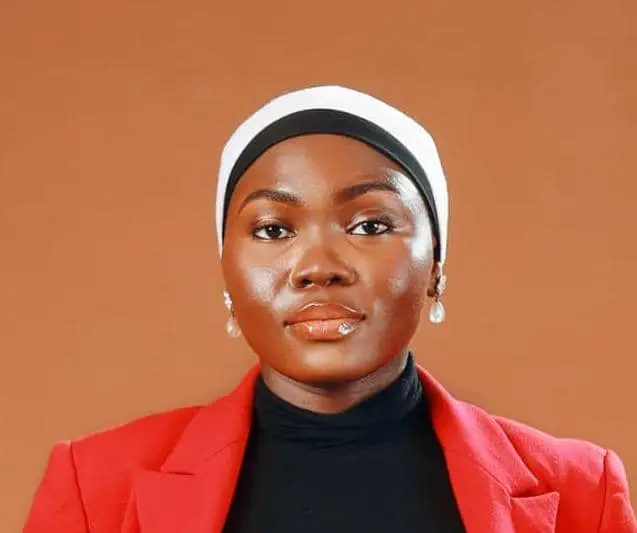
Mahbubat Salahudeen is a Sport Journalist with a primary focus on Youth-Athleticism and women's football.
She is currently pursuing a degree in Media Communications and Public Relations. While much of her experience lies in Sports communications, she has honed transferable skills in strategic communication, audience engagement, and digital media production that transcend industries.
- Mahbubat Salahudeen

- Mahbubat Salahudeen

- Mahbubat Salahudeen

- Mahbubat Salahudeen

- Mahbubat Salahudeen

- Mahbubat Salahudeen

- Mahbubat Salahudeen

- Mahbubat Salahudeen

- Mahbubat Salahudeen

- Mahbubat Salahudeen