



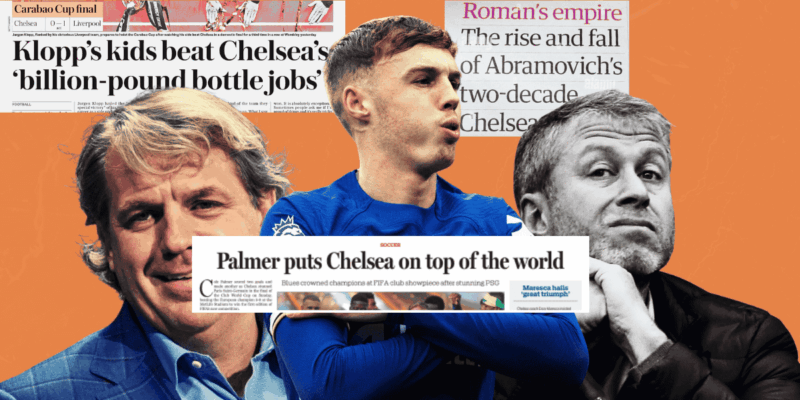
Wembley Stadium, 2024. The Carabao Cup Final should have been Chelsea’s chance to end a poor season on a good note. Instead, they left the pitch beaten by a Liverpool side stitched together from academy prospects and bench players.
The upset was damaging enough, but the conversation that followed cut even deeper.
Gary Neville, on co-commentary duties, dropped a phrase that spread quickly through football discussion and stuck like glue amongst fans and opposing teams alike.
“Klopp’s kids against the blue billion-pound bottle-jobs.”
Jamie Carragher added his voice, insisting the tag would remain until Chelsea delivered a major trophy.
Eighteen months later, the punchline hasn’t aged well for Neville. Chelsea, the supposed bottlers, are now a better team than his cherished Manchester United.
Armed with a Conference League crown and a Club World Cup win over the reigning European champions, PSG, the future of Chelsea looks bright.
For two decades under Roman Abramovich, winning became Chelsea’s identity. Success was seen as a routine, almost expected. But a brutal invasion, a sudden sale, a change in ownership, and a few barren seasons changed the narrative.
The End of the Roman (Abramovich) Empire
At the start of 2022, Europe was thrown into chaos. The war between Russia and Ukraine spread fear and uncertainty. Trade was disrupted, sanctions were everywhere, and even sport could not escape.
For years, Russian billionaires had invested heavily in the United Kingdom. But as the British government moved to stand firmly with Europe, those ties had to be cut. Businesses were seized, fortunes dismantled.

Roman Abramovich was among them. More than just a wealthy man with links to Moscow, he was the figure who had turned Chelsea into a modern powerhouse. But in the storm of politics, even he could not keep what he loved.
The government came for his pride and joy, Chelsea. The club he had built into one of football’s greatest success stories was taken from him.
In isolation, this would sound like a classic case of government overreach, but considering Abramovich’s ties to the Kremlin, the UK government had to make an example of him.
His billions reshaped the club’s identity, but success came at a cost. Mountains of cash, and even that was never a guarantee. For years, Chelsea’s excellent recruitment ensured the winning formula rarely failed.
The question on everyone’s mind was simple: who would succeed Roman and show the same passion and devotion to Chelsea?
The Todd Boehly Gamble
Raine Group, the New York bank handling Chelsea’s sale, faced huge interest but also a major obstacle: Abramovich insisted any new owner commit heavily to infrastructure, especially the stadium, squad, and academy.
Few could match Abramovic’s spending. But Todd Boehly, a longtime investor in sports and co-owner of the Los Angeles Dodgers and Los Angeles Lakers, meant business.

In May 2022, a partnership between himself and Clearlake, a private equity firm, led to the acquisition of Chelsea for a record-breaking sum of £4.25 billion.
The deal came with a promise of £1.75 billion investment in Stamford Bridge, the academy, the women’s team, and the Chelsea Foundation. Boehly assumed the role of chairman alongside Clearlake.
The vision was clear: restore Chelsea’s competitiveness through long-term planning and deep infrastructure growth.
Todd Boehly’s era began with upheaval, marked by the high-profile departure of top club executives Marina Granovskaia, Bruce Buck, and Guy Lawrence. Despite his inexperience, Boehly took on sporting director duties and spent $290m on signings like Raheem Sterling, Kalidou Koulibaly, Wesley Fofana, and Pierre-Emerick Aubameyang.
After a home loss in the Champions League to Dinamo Zagreb, Tuchel was shown the way out of the door just seven games into the season.
The new American owner just sacked the manager who just won Chelsea the European Cup. Fans wanted Boehly’s head on a spike.
Boehly Ball Begins
After Tuchel’s exit, Boehly chose Graham Potter, known for developing young talent at Brighton. Appointed on 9 September 2022, he was tasked with reviving Chelsea’s failing form while adapting to a club under new direction.

January brought a bold shift. Chelsea snatched Mykhailo Mudryk from Arsenal’s grasp with an offer Shakhtar Donetsk could not refuse. The club marked this moment by unveiling the winger draped in a Ukrainian flag, an image that contrasted sharply with the club’s Abramovich past.
Soon after came Enzo Fernández, newly crowned World Cup winner, for a record £105 million on an unprecedented eight-year deal.

The spree and long contracts raised questions, but with Abramovich’s £1.5 billion debt written off and contracts stretched through amortization, Chelsea’s financial strategy became clear.
The stage was set: Potter now had an overhauled squad, heavy investment behind him, and the expectation to turn Chelsea’s gamble into results.
The Graham Potter Era

Chelsea’s gamble on Potter unraveled quickly. Performances sank further, results dried up, and the stadium grew restless as fans questioned both the owners and their costly recruits.
With the season slipping away and barely eight weeks left in the season, the board fired Graham Potter, ending his reign just seven months into a five-year deal.
The numbers told the story: over £550m spent, only 12 wins from 31 games. Supporters were left disillusioned, convinced this was no bargain but a costly mistake.
In a twist of irony, Frank Lampard, once deemed not good enough, was brought back as interim manager to steady the ship. His return did little to change fortunes, and Chelsea managed a dismal 12th-place finish.
As summer approached, the cycle reset. Another manager was gone, and the hunt for the next figure to lead Chelsea began again.
The Mauricio Pochettino Era
Recruiting the right coach is one of football’s toughest challenges. An elite manager can reshape an entire club, and in 2023, Chelsea believed they had found theirs.
Mauricio Pochettino, fresh from an unconvincing spell at PSG, carried baggage but also a pedigree from taking Spurs to a Champions League final.

Chelsea chose to see the potential for revival, and his unveiling that summer carried the assurance of a man who had been there before.
The transfer window backed that vision. Cole Palmer, starved of opportunities at Manchester City, was convinced to join as the face of Chelsea’s new project, a clear departure from the days when the club casually discarded young talents like Kevin De Bruyne and Mohamed Salah.
Moisés Caicedo followed, turning down Liverpool to sign for Pochettino, a decision that hinted at renewed belief in Chelsea’s direction.
But promise soon gave way to disappointment. Pochettino missed out on Champions League qualification and lost the Carabao Cup final to Liverpool’s academy-heavy side.
After Virgil van Dijk scored the winning goal, Gary Neville dropped a statement that irked Chelsea fans across the world. “Jurgen Klopp’s kids have beaten the blue billion-pound bottle jobs!”
Rival fans didn’t need new material; the “bottle job” soundbite had a nice ring to it.
By season’s end, Chelsea reverted to type. Pochettino was dismissed, and the cycle reset once more. The only question left hanging in the air: who would step in next, and could anyone finally restore Chelsea’s winning identity?
The Enzo Maresca Renaissance
Pep Guardiola’s coaching tree had begun to grow. Still, only Mikel Arteta had truly stepped out as a contender, pushing his mentor for the Premier League title in back-to-back seasons.
Down in the Championship, however, Enzo Maresca was quietly making waves, guiding Leicester City back to the top flight after just one year away.

Amid a wave of interest in young, modern coaches, Chelsea took a gamble on Maresca. He lacked Premier League experience, and fans were wary, but after seasoned managers had failed, a new approach was welcome.
His first major act was bold: Clearing out players he saw as surplus, including the shock departure of Conor Gallagher, a key figure in recent squads.
The replacements weren’t marquee names but hungry, ambitious talents. Additions like Noni Madueke and Pedro Neto reflected a strategy built on potential and drive rather than stardust.
Unconventional decisions like splitting the squad for the continental and domestic games drew questions from all corners. With hindsight, it is easy to see the genius of using an alternate squad in order to keep the main guys fresh throughout a gruelling season.
The payoff came swiftly. In his debut season, Maresca delivered the Europa Conference League, thrashing Real Betis 4-1 in the final and making Chelsea the first club to complete the set of all major European trophies.
This was no accident. Through careful rotation between league and Europe, his side stayed sharp across competitions.
Critics argued the level of opposition was lower, but sustaining consistency across such a crowded schedule demanded tactical clarity—and Maresca had shown he had it.
The Return of the Blues
Chelsea ended the season with more than just silverware. A fourth-place finish secured their return to the Champions League, though the path was far from smooth.
A strong start gave way to a bleak winter, with losses to weaker sides and costly draws threatening to undo their progress. Yet, as rivals faltered, Maresca steadied the team in the run-in and delivered the results needed.
The Club World Cup in July posed an even bigger test. With giants like Real Madrid, PSG, and Manchester City in the field, few expected Chelsea to go all the way.
After a shock loss to Flamengo, Maresca’s side regrouped to advance to the latter stages. And in the final, they produced a tactical masterclass, nullifying PSG’s possession game and scoring three against the reigning European champions.

With the tournament not set to return until 2029, Chelsea fans will cling proudly to the rare triumph.
For them, it was more than a trophy haul: it was the end of the “bottle job” tag. Chelsea are now champions of the world. Under Maresca’s stewardship, the real Blues were back at Stamford Bridge.
The New Chelsea: Contenders or Pretenders?
Chelsea entered the new season with renewed optimism, balancing shrewd signings with the departure of fringe players. The additions of Gittens, Joao Pedro, Liam Delap, and Hato brought variety and quality, giving Maresca a squad with both depth and dynamism.
But with depth comes a mountain of concerns. The infamous Bomb Squad of unwanted Chelsea players is already good enough to play for a team in the Prem.

But due to sporting and administrative reasons, these players have been exiled from the first team and made to explore loan and permanent deals away from Cobham.
Concerns over FFP were quelled with a £27 million fine paid, though the club must tread carefully to avoid further sanctions.
On the football side, expectations remain high, but challenges loom. Rivals have also strengthened, and the demands of Champions League football will stretch a relatively young squad.
Experience, often the decisive factor in Europe’s biggest moments, is still scarce in Chelsea’s dressing room.
Yet, if history has shown anything, it is that Chelsea thrives when underestimated. The Blues may not dominate, but as reigning world champions, they carry momentum and belief.
Whether Maresca has another surprise in store remains to be seen, but for now, the “billion-pound bottle jobs” tag is gone for good.
Who wrote this?

Francis Muojindu is a law graduate, journalist, and writer who is always seeking to amplify African Voices in sports.
He primarily covers football, basketball, and athletics with good knowledge of other sports.
When Francis is not bantering with friends, he is on the search for the latest news flying across the globe.
- Francis Muojindu

- Francis Muojindu
- Francis Muojindu

- Francis Muojindu

- Francis Muojindu

- Francis Muojindu

- Francis Muojindu

- Francis Muojindu

- Francis Muojindu

- Francis Muojindu

- Francis Muojindu