


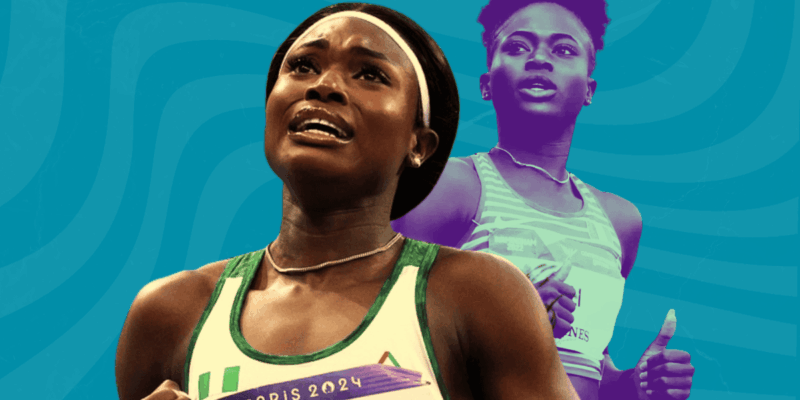
Two Olympic Games. Two disqualifications. For many athletes, competing in even one Olympic Games is a dream. Most never get more than three chances in a lifetime.
So, Favour Ofili had to ask herself some tough questions: How many more Games do I have left? Was my loyalty to Nigeria worth more than my professional future?
Her answer came loud and clear: a move to Turkey, a decision made to protect what’s left of her competitive years and give herself a real chance at the career she deserves.
To understand what pushed her over the ledge, we’ll take you behind the scenes to unpack the shambolic chaos that forced one of Nigeria’s top sprinters, Favour Ofili, to abandon a country she once represented with pride.
Early Life and Rise to Stardom
Favour Ofili was born on December 31, 2002, in Port Harcourt, Rivers State, Nigeria. But she grew up in Delta State, known for producing top athletic talent in Nigeria.
As a secondary school student, Favour Ofili believed in her ability, and with the support of her coach, Annette Otutu, she began her journey on the track.

She started out running the 400 meters, quickly propelling herself to the national and continental spotlight.
In 2017, she won gold at the National Youth Games, earning a spot at the 2018 Africa Youth Games in Algeria. There, she claimed another gold in the 400m.
That same year, Ofili stunned the continent at the African U18 Championships in Abidjan, winning both the 200m and 400m with personal bests of 23.38 and 52.28 seconds. These performances earned her the title of Best Female Athlete of the Championships.
In 2019, Favour Ofili competed at the Youth Olympic Games in Buenos Aires, finishing 10th overall.
Later that year, Ofili stepped up to the senior level at the Nigerian Championships. She won the 200m with a time of 23.32 seconds and came second in the 400m, setting a new personal best of 51.90.
That performance earned her a place on Nigeria’s team for the African Games in Rabat, Morocco. There, she ran another personal best 51.68 seconds to win silver in the 400m and later led the women’s 4x400m relay team to a gold medal.
Being this close to the 50-second and 22-second barriers at such a young age—without any recognisable elite coaching—was a signal to the world of athletics that Favour Ofili was one for the future.
To take that next leap in her career, the only reasonable destination was the United States.
The Next Step: Closer to the Olympic Dream

The year 2020 was a what-dreams-are-made-of kind of year for Favour Ofili. It started with a lucrative scholarship to Louisiana State University, home to world-class track and field athletes like Mondo Duplantis and Sha’Carri Richardson.
This was it: an elite athletic platform with the best facilities and competitors performing at the highest level.
In her first year as a college athlete, Ofili made an immediate impact by winning the 200m at the SEC Indoor Championships with a time of 22.75 seconds.
She also reached the final at the NCAA Indoor Championships. Outdoors, she came close to a medal at the NCAA Championships, finishing fourth in the 200m with a time of 22.45.
With these fast times, Favour Ofili was ready for the big stage, to announce herself at a grand event.
And unknowingly to her, she was about to make the first mistake of her athletic career: she chose to represent her country, Nigeria.
Tokyo 2020 Olympics: The First Strike

On July 28, 2021, two days before the start of the track and field event at the Tokyo Olympics, twenty athletes were disqualified for failing to meet doping compliance rules; ten of them were Nigerians.
The disqualifications arose from Nigeria’s failure to conduct the mandatory out-of-competition drug tests required by Rule 15, which demands at least three no-notice tests over ten months for athletes from ‘Category A’ countries.
Favour Ofili, set to make her Olympic debut, was among those on the banned list. What should have been a career-defining moment turned into a monumental disappointment, denying her the once-in-a-lifetime Olympic dream.
Still, wearing the badge of patriotism, the sprinter redirected her focus to the U20 World Athletics Championships in Nairobi.
She breezed through the 200m heats and semifinals before claiming bronze in the final with a personal best of 22.23
Just a day later, she added two more medals: bronze in the 4x100m and gold in the 4x400m, where she anchored Nigeria to a world U20-leading time of 3:31.4, just 0.62 seconds off the African U20 record.
No complaints, no massive scandal. Ofili put her head down and continued working on improving her time. She hoped that Nigeria would have rectified the mistake that had cost her in Tokyo.
And her times kept improving.
After Ofili’s standout performance at the 2022 Commonwealth Games, it was clear she was no longer just a rising star—she was the future of Nigerian athletics.
Paris 2024: The Final Straw

Paris came with very little hope for Nigerian medals.
With Blessing Okagbare serving a 10-year ban and likely out of the picture for good due to age, Nigeria was ready for a new track queen, young, experienced, and ready.
All eyes were on Favour Ofili in the stacked 100m and 200m events. The whole country marked the first heat on their calendars. Tweets were ready in the drafts for her first race.
But in a crushing blow to the entire nation, Favour Ofili took to social media on July 30, 2024, to announce that she wouldn’t be competing in the 100m. She then further clarified that the Nigerian Athletics Federation failed to submit her name for the event.
The online outrage was deafening. Young people cursed the country’s sports administration. Fellow athletes sympathized with her. But deep down, I knew Favour Ofili was done with Nigeria.
I know we should never attribute malice to that which can be explained by sheer incompetence. But this, happening to the same person twice in 4 years? This was beyond malicious incompetence—this was inherently Nigerian.
As expected, the blame game began. The sports minister launched yet another probe that, like many before it, led nowhere; no one was fired, and no one was held accountable.
After a few days of generic, pacifying press statements aimed at calming angry Nigerians on social media, everything quietly returned to business as usual.
2025: Favour Ofili Turns Her Back on Nigeria

In May, Nigerians everywhere rejoiced as the sprint queen set a new world record in the 150-meter race, clocking an impressive 15.85 seconds at the Adidas Atlanta City Games as the year got into swing for her.
National Sporting Federation elections in Nigeria are held every four years. On June 13, 2025, instead of focusing on ideas for athletic growth, the AFN election became a stage for politicking, lobbying, and last-minute deals.
Tonobok Okowa, the sole presidential candidate, was re-elected despite a first term marked by incompetence and a lukewarm approach to athletics.
His unchallenged return highlights the deep issues in Nigerian sports administration, factionalism, personal interests, and neglect of collective progress.
Here’s the interesting part: Okowa’s re-election means he stays in charge until 2029, a stretch that covers another Olympics, Commonwealth Games, and multiple world championships.
For Ofili, this felt like a gut-punch to a downed fighter. She knew that trusting the same people who had already cost her so much was an exercise in futility.
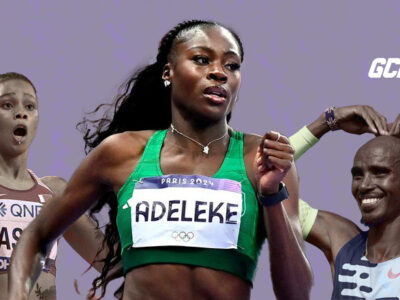
Just a quick look down the lane, former Nigerian athlete Salwa Eid Naser (Ebelechukwu Agbapuonwu) chose Bahrain over Nigeria, and is now an Olympic Silver medalist.

And others have done the same. Francis Obikwelu won silver for Portugal in Athens, Rhashidat Adeleke won silver for Ireland in the 400m, and Annette Echikunwoke also won silver for the USA in the shot put.
The common denominator was that they all turned their backs on their homeland.
So, she walked away. And just like that, Nigeria loses yet another medal contender to a country that simply knows how to value its athletes.
A Silent Deal, a Loud Message: What Ofili’s Exit Means
Defections have long been part of sports. In athletics, especially, Middle Eastern and European countries routinely poach top African talent with mouthwatering offers that are hard to resist.
People love to preach about patriotism and the pride of wearing national colours, but let’s be honest, would you rather represent a country that could actively sabotage your career with wanton disregard?
In a sport that isn’t as lucrative as others and where an athlete’s career window is painfully short, brutal decisions must be made.

If the home front won’t provide support, recognition, or financial security, athletes will go where their talent is valued. And who can blame them?
For Favour Ofili, this move is nothing short of a dream. She’s getting a $500,000 sign-on fee, monthly financial support, a kit endorsement deal, and full access to a world-class training facility.
Turkey is also one of the most rewarding countries an Olympian can represent. The country offers $380,000 for every Olympic gold medal.
Now compare that to Nigeria, where a gold medal gets you just $5,000, and athletes manage on a meagre $100 daily allowance at camps for the Olympics and World Championships.
You get the picture.
A move of this nature ensures that Favour Ofili remains highly competitive for the remainder of her career. With weaker competition for qualification, she stands a chance of finally giving it a last go in 2028.
Hopefully, this time, everything goes according to plan.
Not an Isolated Case: Ofili’s Exit Is Part of a Larger Nigerian Problem
With Favour Ofili’s defection, other Nigerian athletes are quietly drawing up exit plans, waiting for the right offer from nations that value what Nigeria takes for granted. Until Nigeria begins to take athlete welfare seriously and builds a sustainable system that nurtures talent, the exit will continue.
Who’s next? Tobi Amusan? Ese Brume? We may never know until the headlines hit.
Who wrote this?

Francis Muojindu is a law graduate, journalist, and writer who is always seeking to amplify African Voices in sports.
He primarily covers football, basketball, and athletics with good knowledge of other sports.
When Francis is not bantering with friends, he is on the search for the latest news flying across the globe.
- Francis Muojindu

- Francis Muojindu

- Francis Muojindu

- Francis Muojindu

- Francis Muojindu

- Francis Muojindu
- Francis Muojindu

- Francis Muojindu
- Francis Muojindu

- Francis Muojindu