




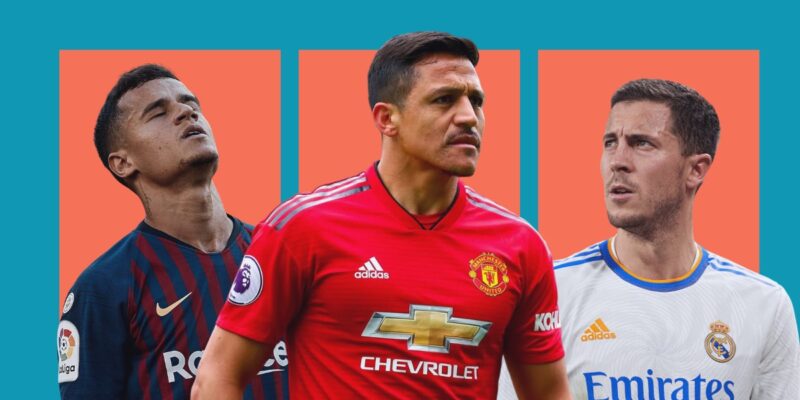
All big transfers in football come with a lot of anticipation: newspaper headlines, “here we go”, record-breaking fees, and unveiling photos.
While these transfers aim to be successful signings, history has shown that things can often go wrong. For every great signing, there is one that turned out to be a disaster.
Factors such as injuries, incompatibility with tactics, personality clashes, or the pressure of high expectations can significantly impact a player’s performance. In some instances, a failed transfer doesn’t just damage a player’s reputation; it can affect their entire career.
From winning the Ballon d’Or or going from a promising wonderkid to losing their spark after a transfer, these are ten signings that went from a fairy tale to a nightmare—ranked from least to most disastrous.
This list illustrates how transfers that once promised so much can lead to heartbreak, highlighting why the biggest transfers often have the highest likelihood of failure.
10. Jack Rodwell –Everton to Manchester City (2012)

Jack Rodwell broke into the Everton first team at just 16 years old and made his senior debut for England in 2011 during a friendly against Spain. Less than a year later, Manchester City came calling and signed him for £12 million ($15 million).
However, this transfer disrupted Rodwell’s career trajectory, as he arrived at City with a persistent hamstring injury that had plagued him since his time at Everton. As a result, Rodwell only made a handful of appearances for the club and struggled to secure a place in the star-studded midfield.
His subsequent move to Sunderland didn’t help, and he never managed to regain his form. His confidence and development suffered greatly, leading him to transition into the English lower leagues and eventually play abroad.
Over seven seasons, Rodwell earned an unwanted record for having the most Premier League games without a win between 2013 and 2017, while battling relegation and trying to revive his once-promising career.
He later became a notable figure in the Netflix documentary “Sunderland ‘Til I Die,” which highlighted the club’s efforts to offload him due to his £70,000-per-week salary.
9. Luka Jović – Eintracht Frankfurt to Real Madrid (2019)

Luka Jović’s transfer to Real Madrid for €60 million in 2019 is one of the most significant failures in recent football history.
The young Serbian striker had just completed an impressive season with Eintracht Frankfurt, scoring 27 goals and establishing himself as one of Europe’s most feared forwards.
Unfortunately, a combination of on-field challenges and off-field issues cut Jović’s fairytale short. He was not the right fit for Zinedine Zidane’s tactical setup.
Moreover, injuries and a COVID-19 illness hindered his first season. As a natural goal poacher, he struggled to compete for playing time against Karim Benzema, who was in exceptional form.
Consequently, Jović received limited minutes on the pitch, leading to a significant loss of confidence. He felt sidelined and was unable to form connections with his teammates.
Additionally, Jović’s struggles were compounded by off-field problems, including public criticism for breaching COVID-19 lockdown regulations and difficulties adjusting to life in Spain.
After a disappointing 18 months, during which he managed to score only six goals for Los Blancos, he went back to Frankfurt on loan. Unfortunately, he failed to regain his previous form, and his chances of having a successful career at the highest level are slim.
Eventually, Jović joined Fiorentina before moving to AC Milan, where he continued to face challenges and struggled to find his footing.
8. Mario Götze – Borussia Dortmund to Bayern Munich (2013)

A commonly referenced cautionary tale regarding failed football transfers is Mario Götze’s decision to join Bayern Munich in 2013.
Having emerged from Borussia Dortmund’s youth system, Götze played a significant role in winning two consecutive Bundesliga championships and was one of the outstanding talents of his generation.
The announcement of his transfer, just before Dortmund’s Champions League final against Bayern, was a bombshell. At that moment, many fans considered it a natural progression for the young star.
However, Götze’s time at Bayern was largely disappointing. Under Pep Guardiola’s management, he often played in positions that differed from his usual attacking midfield role, which hindered his ability to perform at a high level.
The competition for a starting position was intense, and Götze struggled to shine at Bayern as he had at Dortmund. In addition to tactical issues, he also began to suffer from unusual muscle injuries and physical weakness, which further limited his performance.
These problems stemmed from a rare metabolic disorder, and it wasn’t until he left Bayern that he received the correct diagnosis.
In a way, the transfer overshadowed his career to the extent that he could not regain his peak form. Although he scored the winning goal for Germany in the 2014 World Cup final, his career continued to decline afterwards.
His diminishing self-esteem, built up over the years, led him to return to Dortmund in 2016.
After years of struggling at Dortmund, Mario Gotze moved to PSV on a free transfer before finally settling into his role as a veteran playmaker for Eintracht Frankfurt.
7. Mario Balotelli – Manchester City to Liverpool (2014)

Mario Balotelli is infamous for his antics and his “Why Always Me?” shirt celebration. He was one of the most prolific strikers during his successful stints at Inter Milan and Manchester City. His incredible performance in Euro 2012 could have served as a launching pad into the ranks of elite strikers.
Balotelli’s troubles began when he had a clash with Roberto Mancini at Manchester City, which ultimately led the club to sell him to AC Milan.
In 2014, Liverpool acquired Balotelli from AC Milan, hoping to add more firepower to their attack. However, they soon realised that he was not the striker he once was.
His time at Liverpool saw him revert to his old ways, missing training and creating chaos, such as during the infamous fireworks incident in the locker room. He struggled to maintain focus and, on the pitch, he was a shadow of his former self, scoring only four goals in 28 appearances.
Head coaches Brendan Rodgers and Jürgen Klopp were unable to control him, and he became a fringe player who moved from club to club.
Balotelli was unable to revive his promising career and became a liability for any team that signed him. Additionally, he faced racism throughout his career, enduring monkey chants from fans, which contributed to a negative mental state.
His time in Italy was particularly challenging, as he was a victim of racial abuse from fans. There were instances when he would argue with fans during matches due to their abusive comments.
6. Kaka – AC Milan to Real Madrid (2009)

Kaka is one of the few players who has achieved everything in football, from team trophies to individual accolades. He reached the pinnacle of his career when he won the Ballon d’Or in 2007.
In 2009, Kaka joined Real Madrid, becoming part of the “Galácticos” alongside Cristiano Ronaldo, who had already won a Ballon d’Or, and Karim Benzema, who would later win one as well.
However, Kaka’s time at Real Madrid fell short of expectations. He began to struggle with injuries and underwent knee surgery in 2010. These physical issues severely affected his confidence and performance, causing him to spend much of his time on the bench.
Coaching decisions also played a role in his decline. Kaka was not the best fit for José Mourinho’s tactical system and found himself ousted by younger players like Mesut Ozil.
He eventually returned to AC Milan on a free transfer, but he was no longer the superstar that fans remembered. Unable to revive his career, Kaka moved abroad, briefly returned to his first club, São Paulo, and ultimately retired in 2017.
5. Fernando Torres – Liverpool to Chelsea (2011)

At Liverpool, Fernando Torres was a god. He had dominated for three and a half years, scoring 81 goals in 142 matches, and rapidly became one of the most dangerous forwards in the world.
His crowning achievement came for Spain at the 2008 European Championship, where he scored the only goal in the final, securing Spain’s victory.
Then came the British record transfer: an astonishing £50 million move to Chelsea. Fans and experts alike believed he was the missing piece of the puzzle. A hero had arrived, and a new ballad of victory seemed to be on the horizon.
However, the story took an unexpected and unfortunate turn. Barely after joining Chelsea, Torres struggled to find his form. The injuries he had sustained at Liverpool, particularly recurring knee and hamstring issues, had stripped him of what made him great: his lightning pace.
The quick acceleration that had once allowed him to outpace defenders was gone. He found it challenging to adapt to Chelsea’s tactical system, which lacked the creative midfield passing support he had enjoyed at Anfield.
The resulting goal drought was agonising. The once-prolific scorer managed to find the net only once in his first 23 games with the new club. His confidence—a crucial component of his game—dipped with every match he played.
Ultimately, he became just a shadow of his former self, constantly reminded of the legacy he could never reclaim.
Nevertheless, his time at Chelsea wasn’t devoid of memorable moments, such as the stunning goal he scored against Barcelona in the 2012 Champions League semifinal.
His years with Chelsea marked a downward spiral, and by 2014, he was transferred to AC Milan, a move that symbolised the end of his career’s once-promising resurgence.
4. Andriy Shevchenko – AC Milan to Chelsea (2006)

In the summer of 2006, Chelsea’s owner, Roman Abramovich, was inspired to add a spectacular player to his already impressive squad: the striker Andriy Shevchenko, whom he believed could score goals and make a significant impact.
At AC Milan, “Sheva” was a phenomenon. A Ballon d’Or winner, he was nearly unstoppable against defences, tallying an astonishing 127 goals in his first 208 league games and almost 50 goals in the Champions League.
The £30 million transfer was just the beginning, signalling not only domestic and continental dominance but also Chelsea’s ambition to conquer Europe. However, the reality of Shevchenko’s move would turn out to be quite different and tragic.
When he walked onto the Stamford Bridge pitch for the first time, it was evident that Shevchenko was on the decline. The pace that had made him lethal at Milan was already “a yard off”.
Tactically, he had no defined role in the team. José Mourinho’s Chelsea focused on the energy of Didier Drogba, a physical target man who thrived on long balls and hold-up play.
In contrast, Shevchenko, despite being an accurate finisher, often found himself out of position or not playing at all. His once-natural goal-scoring ability had dwindled, and he managed to score only nine goals in 48 league appearances.
Things worsened as tension grew between the manager and the star player. Mourinho demanded relentless hard work from all his players, and there was no room for a “prince” in his team.
The sense of conflict was palpable and very much on display. Shevchenko became increasingly lost, like a “punch-drunk fighter,” wandering through the system without understanding how to contribute.
By 2008, the dream had turned completely bitter. Shevchenko was loaned back to AC Milan, and his name became synonymous with the downfall of his confidence.
3. Alexis Sánchez – Arsenal to Manchester United (2018)

One of the most exciting transfers in January 2018 was Alexis Sánchez’s move to Manchester United, a switch that was expected to shift the balance of power in the Premier League.
The dynamic Chilean forward was at the peak of his performance during his time at Arsenal, where he scored 80 goals in 166 appearances. He was a remarkable talent, a relentless attacking player who had significantly contributed to winning multiple FA Cups for the team.
Manchester United executed a high-profile swap deal with Henrikh Mkhitaryan, securing Sánchez’s signature and eliminating the need to rely on their rivals for talent.
Sánchez was so highly regarded that the club matched his substantial salary, which was between £350,000 and £400,000 a week. It seemed like the beginning of a new era at Old Trafford, as they prepared to welcome their new star.
However, things took an unexpected turn. From the moment he joined, the passionate striker appeared to have lost his spark and reportedly expressed to his agent a desire to return to Arsenal after just one training session.
The charisma, high energy, and intense playing style that he showcased at Arsenal were noticeably absent at United. He was shuffled around the frontline, and José Mourinho’s rigid system was ill-suited for his talent.
Additionally, Sánchez struggled with ongoing health issues, which diminished his explosiveness and stamina—traits that had defined his playing style.
As a result, his drought of goals extended longer, and his confidence swiftly declined. What was once a highly prolific forward turned into a player who managed only five goals in 45 appearances over two and a half years.
By 2020, his contract had expired, and he left for Inter Milan without a transfer fee.
2. Philippe Coutinho – Liverpool to Barcelona (2018)

During the winter of 2018, Philippe Coutinho was excelling at Liverpool, showcasing his brilliance with incredible dribbles and spectacular goals. He had established himself as one of the most exciting attacking midfielders in the Premier League, amassing 54 goals and 45 assists.
Barcelona viewed him as the ideal successor to Andrés Iniesta, and they broke their transfer record to bring him to the club for an astonishing £142 million.
The world anticipated Coutinho effortlessly weaving his magic into Barça’s attack and fulfilling his destiny as a global superstar at Camp Nou. However, what followed was a tragic twist in his tale.
From the moment he arrived, Coutinho struggled to find his rhythm. The injuries he had suffered at Liverpool resurfaced, sidelining him at crucial times. Most disappointing was the evident decline in his confidence.
The bold long-range shots and incisive dribbles that were once his trademarks had become relics of the past. In his debut full season, he scored just nine goals in 40 appearances.
Barcelona lacked a defined position for Coutinho, often playing him out of position as new players joined the team. Supporters who initially welcomed his arrival began to lose faith and even started booing him. He, in turn, recognised that his support was dwindling. The dream had faded, and he had been at the club for only 18 months.
He was subsequently allowed to go on loan to Bayern Munich, where he had some moments of brilliance but was never a first-team player. His career never reached the heights it had at Liverpool.
This transfer has become a cautionary tale, illustrating how form, fitness, and confidence can unravel under the pressure of a hefty price tag.
1. Eden Hazard– Chelsea To Real Madrid(2019)

During his time at Chelsea, Eden Hazard was undeniably the main attraction and the best player on the team. He played 352 games, contributing to the club’s glory by scoring and assisting, which helped them win two Premier League titles.
Eventually, Hazard joined Real Madrid, and the transfer was met with applause, seen as the crowning moment of his career.
Real Madrid paid a record-breaking fee of nearly €100 million to acquire him from Chelsea. Hazard was expected to fill the void left by Cristiano Ronaldo’s departure, and the stage was set for him to shine at the Bernabéu on his way to potentially winning the Ballon d’Or.
However, the story took a shocking and sorrowful turn. From the very beginning, Hazard’s time in Madrid was marred by a series of unfortunate events. In his first season, he suffered a severe ankle injury that required surgery.
This was followed by a troubling sequence of injuries and relapses, leading to a prolonged struggle to regain fitness. He barely featured on the pitch during these three years, making only 76 appearances and scoring just seven goals.
The once-shining star became a mere shadow of his former self. It was evident that his confidence was crumbling, and he failed to secure a stable position in the team, while younger players like Vinícius Júnior were establishing themselves.
Contrary to everyone’s expectations, the move to what was supposed to be a dream club turned into a nightmare, resulting in frustration for both fans and club staff. As a result, he was often viewed as a failure during his time there.
Hazard departed from Real Madrid in 2023 and is now on the verge of retirement. His decline serves as a stark reminder of how a single unfortunate injury can derail even the most gifted players.
Honourable Mentions
While not topping the list of history’s most disastrous transfers, several moves stand out as notable disappointments. Jadon Sancho’s highly anticipated 2021 transfer from Borussia Dortmund to Manchester United failed to live up to expectations, as the winger struggled to find his form.
Danny Drinkwater’s 2017 transfer from Leicester City to Chelsea saw the midfielder barely feature for the Blues after his Premier League-winning season.
In Italy, Gonzalo Higuaín’s controversial 2016 move from Napoli to Juventus commanded a massive fee but ultimately did not lead to the Champions League success the club craved.
Further back in history, Juan Sebastián Verón’s 2001 transfer from Lazio to Manchester United was a high-profile signing that never truly clicked on the pitch.
Finally, Michael Owen’s unexpected 2004 departure from Liverpool to Real Madrid saw the Ballon d’Or winner spend just one season at the Spanish club before returning to England.
Who wrote this?

Hashim Kolawole is a big sports fan who turned his love for the game into a career in sports writing. For him, writing is a way to share his passion for sports with the world.
Hashim also enjoys telling stories about football, basketball, and other sports. He loves reading, traveling, listening to afrobeat and a little bit of hip hop. He is also a chronic candy crush addict.







This is a nice read, but I’m surprised you didn’t mention Neymar. That’s like the worst of them all.
This is a nice read, I’m anticipating your next article.