



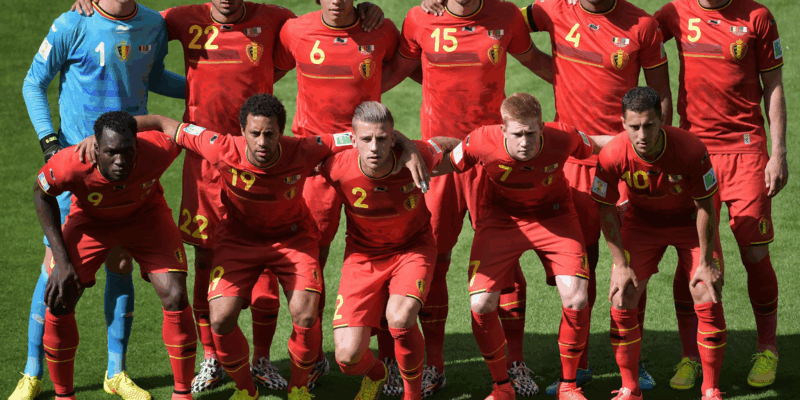

Belgium, at some point in the 2010s, had a collection of some of the best footballers in the world across all positions. Lukaku was unstoppable, Kevin De Bruyne was pulling pink rabbits out of his blue hat, and Courtois was just a brick wall.
And surrounding them were a team of world-class players that looked ready to dominate until the early 2020s.
Yet, despite their impressive talent pool, Belgium’s Golden Generation ultimately became a story of missed opportunities, as they were unable to secure any major international titles.
They topped FIFA rankings and played with high intensity, making them tough to beat. Yet in clutch moments, they faltered.
As this talented generation nears its end, let’s analyze both their successes during this dominant period and how they fell short of ultimate glory.
Before the Golden Generation
To understand how special Belgium’s golden generation is, we must revisit years of obscurity.
For decades, Belgium had average national sides—not strong enough to challenge top teams, but able to defeat weaker ones.
Collectively, they enjoyed spells where they seemingly overachieved. Their best run brought them to the Euro 1980 final, where they narrowly lost 2-1 to West Germany.
Their next commendable run was during the World Cup Semifinals, as the icons of Mexico 1986 fell at the feet of Diego Maradona and went on to lose 2-0 to Argentina.
After this, Belgium returned to normal. From 2002 to 2012, Belgian football stagnated. They had several World Cup exits and didn’t make any significant progress.

Marc Wilmots, “Das Kampfschwein” (The War Pig), was a rare spark in a weak squad, scoring in every 2002 World Cup group game and controversially denied a goal against Brazil.
Luc Nilis and Wesley Sonck added some quality but had little overall impact.
Belgium failed to qualify for the 2006 and 2010 FIFA World Cups and several European championships.
In these wilderness years, Belgium dropped to a record low of 71st in 2007, prompting a systemic overhaul.
Their mediocre performance during the Euro 2000, which they co-hosted, prompted the Belgian FA to devise “Vision 2000” plan.
This strategy comprised a “4-3-3” mandate, which instructed all professional academies to adopt the 433 formation, as it was viewed as the ideal formation to develop young players.
The strategy also involved the services of an auditing firm, Double Pass, which ensured the professional club in Belgium adhered to the directive of the FA.
Ultimately, this framework sparked one of the greatest turnarounds in sports history, as clubs like KRC Genk, Anderlecht, and Standard Liege began to produce world-class talents.
2014 World Cup: The Dawn of The Golden Era
When the Red Devils qualified for the 2014 World Cup, it signaled Belgium’s return to football’s grand stage.
After a twelve-year absence from the world stage, the golden generation had emerged to lead the nation to a long-awaited participation in international tournaments.
Marc Wilmots led the team. Young talents like Eden Hazard, Kevin De Bruyne, and Romelu Lukaku joined experienced players Vincent Kompany and Daniel Van Buyten.
Belgium started the World Cup dramatically, trailing Algeria for over an hour before substitutes Marouane Fellaini and Dries Mertens scored to seal a 2-1 comeback win.

Late drama continued as Divock Origi’s 88th-minute goal secured a 1-0 win over Russia, clinching knockout round qualification after two group wins.
Belgium finished the group stage with a perfect record after a 1-0 win over South Korea.
In the round of 16 against the United States, Belgium created waves of chances, but the U.S. defense, especially their goalkeeper, held firm.
Tim Howard refused to let any shot go past him. He made a record-breaking 16 saves. Eventually, Belgium’s persistence, aided by a key substitution, paid off.
Lukaku, coming off the bench, assisted De Bruyne and then scored himself. Julian Green scored for the U.S. as a consolation.
The following round pitted the tournament’s oldest squad, Argentina, against a Belgian side that ranked as the third youngest among the 32 competing nations.

Gonzalo Higuain’s volley in the 8th minute proved decisive as the Red Devils struggled to find spaces to exploit and muster an equalizer.
Belgium’s run at this edition of the World Cup came to a painful end against a formidable opponent and eventual finalist. Still, their performance declared that the Belgians were now global heavyweights.
Euro 2016: Devoured By The Dragons
After the re-emergence of the Belgians in Brazil, Euro 2016 was viewed as the moment when this generation of players would finally be ready to achieve something great.
Belgium’s path to France was remarkable. The Red Devils lost only once in qualifying. They reached the top of the FIFA world rankings for the first time ever.
Entering the tournament as the highly-ranked European nation, expectations were high, and rightfully so.
As the tournament began, the Belgians were quickly dealt a rude awakening. They struggled to break down the resolute Italian defense and lost 2-0.
Belgium found their rhythm in the following fixture, as Marc Wilmots’ men won 3-0 against the Republic of Ireland, including a clinical brace from marksman Romelu Lukaku.
They secured knockout qualification with a hard-fought 1-0 win over Sweden, as Radja Nainggolan’s goal also ended Zlatan Ibrahimovic’s international career.

The round of 16 against Hungary showcased Belgium at their best: a 4-0 win, with Eden Hazard scoring and assisting.
A quarterfinal matchup with Wales set up an intriguing encounter. Both teams were among the highest scoring in the competition.
Belgium struck first, as Radja Nainggolan scored from range in the 13th minute. Despite a strong start, the absence of defensive leaders Vincent Kompany and Jan Vertonghen hurt Belgium.
Wales equalized when Ashley Williams headed in an Aaron Ramsey corner. With the game now in the balance, the stakes became higher.
The game’s defining moment came in the 55th minute. Aaron Ramsey crossed to Hal Robson-Kanu, who made a “Cruyff Turn,” beat three Belgian players, and scored a Puskas-worthy goal.

Belgium pressed for an equalizer, but Sam Vokes’ late header sealed Wales’ third, leaving Belgium distraught.
The result left the nation questioning how a team filled with star players lost to tournament underdogs in such dramatic fashion.
2018 World Cup: A Bridge Too Far
With Roberto Martinez as manager, Belgium qualified unbeaten for the World Cup, scoring 43 goals in 10 matches.
The “holy trinity” of Eden Hazard, Romelu Lukaku, and De Bruyne led the attack. A strong defense gave the team a good balance.
Belgium breezed through the group stage, beating Panama, Tunisia, and England for a perfect Group G record.
Their round of 16 encounter with Japan was an interesting one, given how Japan had played during the tournament.
Japan led 2-0 early in the second half, putting Belgium at risk of a major upset.
With over an hour played and on the brink of a humiliating exit, Roberto Martinez brought on Marouane Fellaini and Nacer Chadli.
Jan Vertonghen’s fortuitous header started the comeback, followed by Marouane Fellaini’s goal off an Eden Hazard cross.
With seconds left on the clock and the match heading to extra time, Courtois launched a counterattack. Thomas Meunier then sent in a low cross which Romelu Lukaku brilliantly dummied before substitute Nacer Chadli finished with composure.

Brazil became the next test for the Red Devils. The match was expected to be tight. Fernandinho’s own goal early on gave Belgium the lead. Kevin De Bruyne then let one fly from the edge of the box to double their lead.
Brazil kept the game alive courtesy of substitute Renato Augusto’s header in the 76th minute. Despite Brazil’s surge for an equalizer, Belgium progressed to the next round.
The semifinal between Belgium and France felt more like the final itself. In a brilliant tactical masterclass from both sides, a single near-post header from Samuel Umtiti was enough to see France go through to the final.

Belgium found consolation in achieving their highest-ever World Cup finish by defeating England 2-0 to secure third place in Russia.
Euro 2020 (2021): Nightmare in Munich
The 2020 European Championship was played in 2021 due to the COVID-19 pandemic, and Belgium, still occupying the number one spot in the FIFA rankings, was prepared to take on another quest for silverware.
Belgium’s journey to the main stage was superb. They won all ten of their qualifying campaign matches, scoring 40 goals.
They carried the momentum into the group stages of the Euros, seeing off Russia, Denmark, and Finland with ease.
However, their nightmare during the knockout began in the round of 16. Facing defending champions Portugal, they edged out a win via Thorgan Hazard’s screamer in the 42nd minute.
In what seemed like a pyrrhic victory, Belgium lost Kevin De Bruyne early in the second half through a ligament injury and Eden Hazard in the dying minutes of the game with a hamstring injury.

Kevin De Bruyne made a heroic start in the following round, but Eden Hazard on the sidelines meant that the team lost their most creative outlet.
The match in Munich against the Italians quickly became a tactical battle.
Italy drew first blood, capitalizing on the lapses of Belgium’s aging backline through Nicolo Barella after 30 minutes. In the 44th minute, Lorenzo Insigne doubled the lead with a sublime strike from distance.

Jeremy Doku, who started in place of the injured Eden Hazard, provided a rare spark of youthful energy, as he won the penalty, which Romelu Lukaku calmly converted before halftime.
Belgium appeared to have found a leveler when Lukaku seemed destined to score at the back post, but Leonardo Spinazzola’s miraculous goal-line block protected Italy’s lead.
As the match reached its conclusion, Belgium struggled to break a backline anchored by the legendary partnership of Giorgio Chiellini and Leonardo Bonucci, losing 2-1 to the eventual tournament champions.
2022 World Cup: Lukaku’s Night of Horrors
The 2022 World Cup in Qatar presented the Red Devils with another chance at World Cup glory. Belgium, once again, topped its qualifying group without a single defeat.
However, signs of unease began to creep into their camp, with Kevin De Bruyne famously admitting mid-tournament that the squad was “too old” to win.
Belgium were very fortunate to get a 1-0 over Canada in their first match, after being outplayed for most of the proceedings.

The second fixture against Morocco was characterized by a sluggish and lackluster display. They lost 2-0 and provided nothing to trouble the Moroccans.
Entering the final match of the group stages and needing all three points to progress to the next round, they faced last edition’s finalist, Croatia.
With the encounter deadlocked at halftime, Romelu Lukaku was introduced after the break.
What followed his introduction to the game was beyond logical comprehension.

On the hour mark, Yannick Carrasco’s shot was parried to Lukaku, who saw his shot hit the inside of the post from close range.
A few minutes later, Lukaku guided his header over an empty net after Kevin De Bruyne had brilliantly teed him up.
In the 87th minute, Lukaku deflected a shot/cross wide from point-blank range.
In stoppage time, with the net wide open once more, he attempted to chest his shot towards goal instead of heading it, and the shot fell straight into the arms of the keeper.
A final chance in stoppage time was halted after a well-timed tackle by Josko Gvardiol.
The 0-0 draw confirmed Belgium’s group stage exit from the World Cup for the first time since 1998.
As the players retired to the dressing room, Lukaku was seen punching the dugout frame in anger and frustration.
Euro 2024: The Last Dance
The injection of youth into the Belgian national team had changed the identity of Belgium.
Dominic Todesco, who has been at the helm of affairs for just over a year, guided Belgium to an unbeaten qualification campaign.
Despite their performance, the team arrived in Germany with the feeling of transition from the golden era to a rebuilding phase.
The rebuild had an effect on the team, as they lost 1-0 to Slovakia, after Lukaku’s bad luck struck again, having seen two of his goals rescinded by VAR.
Belgium bounced back in the following round, seeing off Romania after Youri Tielemans had opened the scoring just 73 seconds after kickoff. Kevin De Bruyne scored later on to secure the 2-0 win for the Red Devils.

Their final group stage game did not end on a very pleasant note. A barren draw against Ukraine generated negative remarks, as their fans booed the players after the final whistle, despite Belgium progressing to the next round.
The round of 16 fixture pitted the Red Devils against France, a rematch of the 2018 World Cup semifinals.
In what was a rather cagey affair, Belgium approached the clash of titans encounter by deploying a low block and solely relying on counterattacks and half-chances.
In the final ten minutes of the game, Kolo Muani’s shot deflected off Jan Vertonghen’s knee, wrong-footing goalkeeper Koen Casteels, into his own goal.

That single strike condemned the Belgians to an agonizing 1-0 defeat and ended any hopes of securing silverware.
Belgium’s exit from this tournament ultimately marked the beginning of the end for the golden generation.
The much-coveted silverware somehow eluded this star-studded generation of players, leaving the question of whether the players did enough to win or if they were not good enough.
What Next for Belgium?
As Belgium approaches the inevitable end of the golden generation, a fresh generation of players is integrated into the team.
Core players of the golden generation like Eden Hazard, Jan Vertonghen, Vincent Kompany, Toby Alderweireld, and Dries Mertens have all retired from International football, with Hazard and Kompany closing the curtain on their illustrious careers.
Axel Witsel, the nation’s most capped player, plays a fringe role in the national team. Kevin De Bruyne, Romelu Lukaku, and Thibaut Courtois have struggled with injuries and match fitness recently, and this affects their involvement in the national team.
Belgium can still look to the future with hope and aspirations, as the young players being integrated into the team have shown that they can also lead the nation to great heights.

Jeremy Doku, Charles De Ketelaere, and Johan Bakayoko provided the spark in attack, while the likes of Amadou Onana and Arthur Vermeeren provided the stability and creativity in midfield.
Their defense has been questionable in recent years, but with Zeno Debast, Koni De Winter, and goalkeeper Senne Lammens developing well at their respective clubs, the defensive unit of the Red Devils shows great promise as well.
Under current manager Rudi Garcia, Belgium have switched tactics to a transition-oriented 433 or 4231, as opposed to the 3421 they notoriously deployed under Roberto Martinez.
This style encourages a more direct approach and utilizes wing play, feeding the ball to direct wingers and creating chances through overlapping fullbacks.
The players Belgium have in their ranks can achieve something worthwhile and even have the potential to match the golden generation or even surpass their achievements.
However, this all depends on how fast these groups of players can find their rhythm and compete against other top nations.
Who wrote this?

Bienuoma Agaga-Akpati is a software engineer, writer, eSports player, and sports enthusiast, presently working with a group of ambitious Africans to transform the writing industry. With good knowledge of various sports and eSports, coupled with his keen ability for research, he loves analyzing ideas and topics that fosters the growth of the sport and eSports scenes. In his spare time, he enjoys creating content and engaging in discussions across various platforms.
- Bienuoma

- Bienuoma
- Bienuoma
- Bienuoma
- Bienuoma
- Bienuoma

- Bienuoma

- Bienuoma

- Bienuoma

- Bienuoma

- Bienuoma

- Bienuoma

- Bienuoma

- Bienuoma

- Bienuoma

- Bienuoma

- Bienuoma
- Bienuoma
- Bienuoma
- Bienuoma

- Bienuoma
- Bienuoma

- Bienuoma
- Bienuoma

- Bienuoma
- Bienuoma

- Bienuoma

- Bienuoma

- Bienuoma

- Bienuoma