



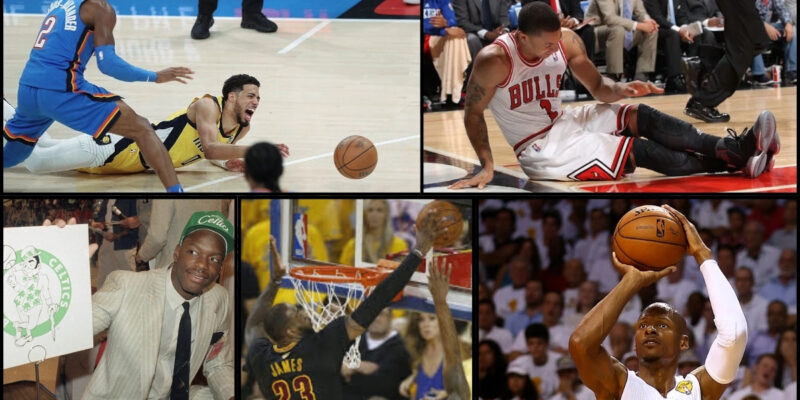
NBA history lives as much in its near-misses as in its triumphs. Careers hovered on the edge of transformation. Dynasties were almost formed.
Quiet decisions reshaped the league without much fuss. Behind every championship banner and immortal highlight sits an unanswered question—what if it had gone another way?
On May 12, 2019, during Game 7 of the Eastern Conference Semifinal, one such moment unraveled.
The score was tied at 90-90. Only 4.2 seconds remained on the clock. Marc Gasol inbounded to Kawhi Leonard at the top of the arc, who drifted towards the baseline and launched a high-arching fadeaway over Embiid’s outstretched hand just before the buzzer sounded.
The ball hit the front of the rim, bounced high, then struck the rim again and again—four times in total. The arena fell silent as both teams held their collective breaths.
On the fourth bounce, the ball finally crawled over the rim and through the net. It was the first time in NBA history that a Game 7 was decided by a buzzer-beater.
Kawhi Leonard’s one-bounce shot against Philadelphia continues to ripple through time, altering paths with a single pause in the air.
What if the shot had not gone in? What if the match went to overtime and the 76ers won the series? So many things could have gone differently if Kawhi’s circus shot had not trickled through the net.
There are several occasions of similar moments where, if events had turned out differently at significant moments or junctures, the outcomes could have been different.
This article explores the NBA’s biggest What Ifs and why possibilities left unanswered often resonate as deeply as greatness fully realized, leaving us to wonder how different the story might have been.
11. Arvydas Sabonis joined the NBA in his prime

When the Portland Trail Blazers drafted Arvydas Sabonis in 1986, the NBA brushed up against an alternate future.
Arvydas Sabonis was already Europe’s best, a 7-foot-3 star who passed like a guard, shot confidently, and dominated space as few others had.
Then reality intervened. Politics delayed him. In the 1980s, the ‘Iron Curtain’ made it nearly impossible for Soviet athletes to play in Western leagues like the NBA.
Draft complications with the Atlanta Hawks (1985) and Portland Trail Blazers (1986) delayed his NBA debut.
The physical toll and injuries from overuse and poor recovery also took their toll. By the time Sabonis debuted in 1995, both he and the moment had slowed.
Now imagine the buzz if Sabonis had entered the league in his true prime. Picture him facing Hakeem Olajuwon, David Robinson, and a young Shaquille O’Neal on equal physical terms.
Clyde Drexler’s window might have stayed open, the West less predictable, and the league forced to rethink the center’s role.
It’s easy to imagine what might have been seeing today’s players like Nikola Jokic and Victor Wembanyama.
Like Jokic and Wembanyama, Sabonis was a ‘Big Man’ with unprecedented skills before entering the NBA.
Instead, Sabonis arrived as just an echo of his former self. Had he debuted earlier, he might be remembered as one of the NBA’s greatest foreign players.
10. Draymond never kicked LeBron in the nuts

In the 2016 NBA Finals, the Golden State Warriors led 3–1, played historic basketball, and seemed destined to win it all.
With less than three minutes remaining in the fourth quarter of Game 4, Draymond Green and LeBron got tangled up near half-court.
Green fell, LeBron tried to step over him, and Green swung his arm upward, making contact with LeBron’s groin.
Both started jawing and had to be separated. No flagrant was called during the game.
However, the NBA reviewed the footage the following day and retroactively assessed Green a Flagrant Foul 1 for a “retaliatory swipe to the groin”.
Under the NBA rules, a fourth flagrant foul point during the postseason triggers an automatic one-game suspension. As a result, Green was suspended for Game 5.
The suspension altered the Finals’ emotional temperature. Golden State lost a vital cog in its well-oiled system for Game 5. On the other hand, the suspension breathed life into the dying hope of Cleveland’s quest for a Chip.
Cleveland secured the dub in Game 5 and dramatically won the Championship at the Warriors’ home arena.
Remove that moment, and the series likely plays out as expected. Draymond’s presence keeps Golden State’s defense strong as they crush the Cavs in Game 5.
LeBron still delivers brilliance, but brilliance meets resistance sooner. The door may close before doubt ever enters the room. Kevin Durant’s future tilts and legacy arguments soften.
Instead, history remembers the greatest comeback in NBA history, and LeBron James wins his heaviest ring for his home team.
9. Jordan didn’t retire after the first 3-peat

Michael Jordan’s first retirement in 1993 created perhaps the ultimate “what if” moment at the very summit of basketball greatness.
“A man who has won it all has nothing left to win” is a familiar quote among sports personalities, and this was Jordan’s fate.
With what remains one of the most shocking announcements in sports history, Jordan announced his retirement on October 6, 1993, just a few months after winning his third consecutive championship against the Phoenix Suns.
At just 30 and still the world’s top player, many expected Jordan to keep dominating the NBA and winning titles.
Instead, the loss of his father, mental exhaustion, and gambling scrutiny drained Jordan’s motivation.
Jordan returned to the NBA on March 18, 1995. After a brief adjustment period, including a playoff loss to the Magic, he led the Bulls to three more titles in 1996, 1997, and 1998.
In spite of the success after his return, many cannot help but ask what if he had not retired after the first three-peat.
Jordan returns in optimal shape and form, and the Bulls defend their title with continuity rather than recalibrating the future without Jordan.
A fourth straight title alters more than the record books, Scottie Pippen’s trajectory shifts, and Phil Jackson manages strain instead of revival.
The question evolves from “Can anyone stop him?” to something more unsettling: “Can he stop himself?”
Lost seasons matter, even after a comeback. Time never returns what it takes, and for Jordan, those years could have brought more greatness.
8. Greg Oden stayed healthy

Greg Oden entered the NBA carrying the hopes of a future franchise player. Chosen first overall by Portland in 2007 ahead of Kevin Durant, he was seen as the next generational big man.
His body looked prepared, his defense felt inevitable in an era that prioritizes defense and intense physicality.
Unfortunately, before he played any meaningful minutes, injuries intervened, slowing the moment and splintering anticipation.
Oden’s career was derailed by chronic knee issues that ended it almost before it began. Across seven years in the NBA, he played only 105 games.
Now imagine the injuries did not surface very early in his career. Oden steps into rhythm instead of recovery.
He anchors the paint while Brandon Roy controls the perimeter and LaMarcus Aldridge stretches the floor.
A healthy Oden could have been the perennial Defensive Player of the Year candidate that many expected.
The Blazers could have stolen the spotlight that shone on the emerging Golden State Warriors and been the primary roadblock to the Warriors’ rise in the mid-2010s.
Also, the Kevin Durant comparisons would not sound as bizarre as they do now. If Oden had stayed healthy and become a 20-point, 10-rebound, 3-block player, the debate over drafting him ahead of Kevin Durant would likely be viewed as a “win-win” rather than one of the biggest draft blunders in NBA history.
The reality still stings because Oden’s injuries not only cut short his NBA career but also impacted the franchise’s immediate future.
7. Drazen Petrovic didn’t die too early

Drazen Petrovic, known as the “Mozart of the Parquet”, is often considered the most significant international pioneer in NBA history.
By 1993, he had earned recognition as the franchise’s star player. The New Jersey Nets were on a positive trajectory, and Petrovic’s teammates truly believed he would make the right play at any moment.
Petrovic’s career was cut tragically short as he neared superstardom when he died in a car accident on June 7, 1993, at age 28.
The tragedy happened just after the 1992-93 NBA Season, when he had been named to the All-NBA Third Team.
Before his death, Petrovic shattered the NBA’s European Stigma. Had he lived, he might have changed the 1990s NBA landscape.
In his final season, he averaged 22.3 points per game on incredible efficiency. We can only imagine how many barriers would have fallen and how many new standards he could have set.
At a time when the three-point shot was secondary, Petrovic was a modern-day shooter in a 90s body. He was on pace to become a perennial All-Star and potentially a 25+ PPG scorer.
Jordan once called Petrovic his “most difficult opponent” because of his fearlessness and relentless trash-talking. A mid-90s rivalry between the two would have been one of the league’s most competitive storylines.
Things could have turned out differently for Petrovic, the New Jersey Nets, and the entire NBA had that tragic accident not occurred on the Autobahn in Denkendorf, Germany.
While Petrovic paved the way for players like Dirk Nowitzki and Pau Gasol, his continued success likely would have opened the doors for European talent even sooner. He proved that an international player could be the number one option on a winning NBA team.
6. OKC never traded James Harden

James Harden’s stint at the Oklahoma City Thunder is widely viewed as a “High Peak, Short Duration” affair.
Harden was the 3rd overall pick in 2009 and quickly accepted a unique role for a player of his caliber: the Sixth Man.
While Kevin Durant and Russell Westbrook were the primary stars, Harden was the “closer.” He led the second unit but often stayed on the floor during the final minutes of close games.
His breakout year occurred in 2012, during which he averaged 16.8 points on high efficiency and won the NBA Sixth Man of the Year award.
At just 22 years old, Harden was instrumental in helping the Thunder beat the Spurs in the Western Conference Finals.
However, he struggled in the 2012 NBA Finals against the Miami Heat, which some believe made the Thunder’s front office hesitant to meet his contract demands.
In October 2012, after failing to agree on a contract extension, the Thunder traded him to the Houston Rockets in a move that shocked the sports world.
If the Thunder had paid the luxury tax and kept the trio together, the NBA landscape of the 2010s would have likely been unrecognizable.

Most analysts believe the Thunder would have won at least 2–3 championships.
Kevin Durant most likely wouldn’t have left OKC. If Harden was still there, the Thunder likely beat the Warriors in the 2016 WCF, and Durant stays in Oklahoma City.
Harden likely wouldn’t have become a 36-PPG scorer as he did in Houston. Rather, he would have likely transitioned into a starting role similar to Manu Ginóbili, focused on efficiency and playmaking rather than high-volume scoring.
In hindsight, the career of Harden and the rest of the trio turned out fine, especially Durant, but an OKC team that possessed the trio longer could have achieved greatness.
5. Ray Allen missed the 2013 Finals Game 6 shot

Ray Allen’s performance in the 2013 NBA Finals is defined by a single moment that saved the Miami Heat’s season.
Coming off the bench as a 37-year-old veteran, Allen was the “safety valve” for the Big Three of LeBron James, Dwyane Wade, and Chris Bosh.
With 5.2 seconds left and the Heat down by 3 in Game 6, LeBron James missed a game-tying three. Chris Bosh grabbed the offensive rebound and passed the ball to Allen, who was backpedaling toward the right corner.
Without even looking down to check his feet, Allen stepped behind the arc and drilled the three-pointer to tie the game at 95–95.
The Heat won in overtime and went on to win Game 7 to secure the championship. Allen finished the series averaging 10.6 points and shooting 54.5% from three, but that one shot outweighed all other stats.
If that ball clanks off the rim, the ripple effect would have fundamentally changed the history of the modern NBA.
Ultimately, it would have marked the end of the “Heatles”. Ray Allen himself has said that if he missed, the team likely would have disbanded.
LeBron’s Finals record would have dropped to 3–7 (or worse, depending on the years to follow) instead of 4–6.
If the Spurs had won, Tim Duncan would have moved to 6–0 in the NBA Finals, matching Michael Jordan’s perfect record. Kawhi Leonard, then just a sophomore, would have won his first Finals MVP at age 21.
Let’s not forget Tracy McGrady was on the 2013 Spurs bench. If Allen misses, one of the greatest scorers in history retires with a championship ring instead of finishing his career ringless.
Ray Allen played a secondary role for much of the series, but his contribution in Game 6 is arguably the most clutch shot in basketball history.
4. The Lakers traded for Chris Paul

On December 8, 2011, a three-team trade was finalized between the Lakers, the New Orleans Hornets, and the Houston Rockets.
The Lakers had agreed to acquire Chris Paul, a move that promised a monumental coup for the Lakers.
Within 45 minutes of the news breaking, NBA Commissioner David Stern voided the trade.
The veto rerouted everything.
If the trade had gone through, the “Laker era” of the 2010s would have looked entirely different.
Kobe Bryant and Chris Paul were arguably the two most competitive, high-IQ players in the league.
At 33, Kobe was still elite but carrying a massive physical load. With CP3 handling the ball and playmaking, Kobe could have transitioned into a more efficient scoring role.
The Lakers still had the assets (Andrew Bynum) to trade for Dwight Howard in 2012. A “Big Three” of CP3, Kobe, and Dwight would have been a defensive juggernaut and a legitimate threat to the Miami Heat’s LeBron-Wade-Bosh dynasty.
If CP3 goes to the Lakers, he never goes to the Clippers. The “Lob City” era, which made the Clippers relevant for the first time in history, never happens.
Without getting Pau Gasol in this trade, the Rockets would have kept their assets. Harden might have ended up elsewhere, or stayed in OKC even longer.
Because the Hornets didn’t get the “veteran” package from the Lakers, they became one of the worst teams in the league.
This led to them winning the 2012 Draft Lottery and selecting Anthony Davis. If they had taken the Lakers’ deal, they likely would have been a mediocre playoff team and never would have had the chance to draft AD.
A lot could have been different had that deal gone through, but fans are left to wonder what could have been for everyone involved.
3. Len Bias didn’t die before he joined the NBA

On June 17, 1986, the Boston Celtics selected Len Bias with the No. 2 overall pick in the NBA Draft. At the time, the Celtics were the defending NBA champions, with Larry Bird, Kevin McHale, and Robert Parish still calling shots and dominating.
The addition of Len Bias to the Celtics roster indicated the Celtics had no intentions of relinquishing their title as the best team in the league.
After a whirlwind media tour in New York and Boston, Bias returned to his dorm at the University of Maryland to celebrate with friends.
In the early morning hours of June 19, 1986, less than 48 hours after the draft, Bias collapsed after using cocaine.
He was pronounced dead at 9:00 AM due to cardiac arrhythmia induced by a cocaine overdose. He was only 22 years old. His death shocked the nation and became a massive catalyst for the “War on Drugs.”
If Bias hadn’t kicked the bucket and joined the 1986-87 Celtics, the trajectory of the NBA in the late 80s and 90s would have shifted dramatically.
The 1986 Celtics are considered one of the best teams ever, but their core (Bird, McHale, and Parish) was beginning to age and suffer from chronic injuries. Bias was intended to be the “bridge” to the next generation.
With his athleticism, the Celtics likely would have remained the favorites over the “Bad Boy” Pistons and the Lakers well into the 1990s.
In college, Bias was one of the few players who could go toe-to-toe with Michael Jordan. Scouts described him as a “Jordan-type player who was bigger and had a better jump shot.”
An Eastern Conference rivalry between Jordan’s Bulls and a Bias-led Celtics would have been the defining matchup of the 90s.
Following Bias’s death and the later passing of star Reggie Lewis in 1993, the Celtics entered a “dark age” that lasted nearly 20 years.
2. Derrick Rose didn’t get injured

Derrick Rose’s career is one of the most poignant “what-if” stories in sports. He went from being the youngest MVP in NBA history to a journeyman role player, forced to reinvent his game after several devastating knee injuries.
Fans saw the saddening change unfold as seasons passed and everyone, at some point during his career, hoped he could recover his spark.
On April 28, 2012, during Game 1 of the playoffs against the 76ers, Rose tore his ACL in his left knee while driving to the basket.
He missed the entire 2012/13 season. Upon his return that same season, he played just 10 games before tearing the meniscus in his other knee.
Over the next few years, he suffered multiple additional knee and ankle surgeries.
If Rose had remained healthy, the NBA landscape of the 2010s would likely have shifted away from the “Superteam” dominance in the East.
In 2011, the Bulls had the best record in the NBA and reached the Eastern Conference Finals. A healthy, prime D-Rose would have been the biggest threat to LeBron James’ path to eight straight Finals. The Bulls likely would have won at least one championship in the mid-2010s.
Rose was a very explosive point guard who relied on unprecedented speed and verticality. Without injuries, he likely would have spent his summers developing a consistent three-point shot much earlier, making him a truly unguardable three-level scorer.
Every single MVP in NBA history is in the Hall of Fame (or will be). Rose’s career total of 12,573 points is lower than most legends due to missed time. A very fit Rose likely finishes with 20,000+ points and 5,000+ assists, making him a first-ballot lock.
Things could have been very rosy for D-Rose and the Bulls had that unfortunate injury not occurred in 2012.
1. Haliburton didn’t get injured

Timing is everything, but what happens when a franchise’s ace goes down in agony in a Game 7 of the NBA Finals after sinking three 3-point shots in the opening minutes of the game?
This was the unfortunate fate of Tyrese Haliburton during the 2025 NBA Finals.
Tyrese Haliburton’s 2025 postseason was a historic breakthrough for both him and the Indiana Pacers.
However, much like the other “what-ifs” in basketball history, it was defined by a critical injury at the worst possible moment.
Haliburton established himself as the engine of the highest-rated offense in the league, leading Indiana to their first NBA Finals appearance in 25 years.
He became known for his “clutch” gene, hitting go-ahead or game-tying shots in every single round during the 2025 NBA postseason.
Haliburton was instrumental in taking the 68-win Oklahoma City Thunder to a seven-game series.
Just over seven minutes into the first quarter of Game 7, while driving to the basket, Haliburton suffered a non-contact injury, later confirmed as a torn right Achilles tendon.
While the Oklahoma City Thunder ultimately won the title 103–91, many analysts and fans believe the outcome could have been different had Haliburton stayed healthy.
Without Haliburton, the Pacers’ offense stagnated. They were outscored 34–20 in the third quarter as they struggled with lazy turnovers and forced shots that Haliburton’s elite playmaking typically prevented.
Due to the severity of the Achilles tear, Haliburton has been ruled out for the entire 2025-26 season and is currently in the rehab process.
Game 7’s are generally unpredictable, but had the Pacers had Haliburton present for the entire game, his presence likely would have kept the Thunder’s defense from focusing entirely on trapping Pascal Siakam and Benedict Mathurin, and the Pacers would have won their first-ever NBA title.
Who wrote this?

Bienuoma Agaga-Akpati is a software engineer, writer, eSports player, and sports enthusiast, presently working with a group of ambitious Africans to transform the writing industry. With good knowledge of various sports and eSports, coupled with his keen ability for research, he loves analyzing ideas and topics that fosters the growth of the sport and eSports scenes. In his spare time, he enjoys creating content and engaging in discussions across various platforms.
- Bienuoma

- Bienuoma
- Bienuoma
- Bienuoma
- Bienuoma
- Bienuoma
- Bienuoma
- Bienuoma

- Bienuoma

- Bienuoma

- Bienuoma

- Bienuoma

- Bienuoma

- Bienuoma

- Bienuoma

- Bienuoma

- Bienuoma
- Bienuoma
- Bienuoma

- Bienuoma

- Bienuoma
- Bienuoma

- Bienuoma
- Bienuoma
- Bienuoma

- Bienuoma
- Bienuoma

- Bienuoma

- Bienuoma

- Bienuoma