



The anticipation was palpable on June 30, 2014, as the quarterfinals matchup between Die Nationalmannschaft of Germany and Algeria’s Les Fennecs loomed.
Ideally, the hype surrounding the fixture revolved around how both teams’ tricky and lethal attacks would break down their respective defenses.
However, with the game still in a deadlock, the unexpected hero of the game was a goalkeeper who had delivered a performance for the ages.
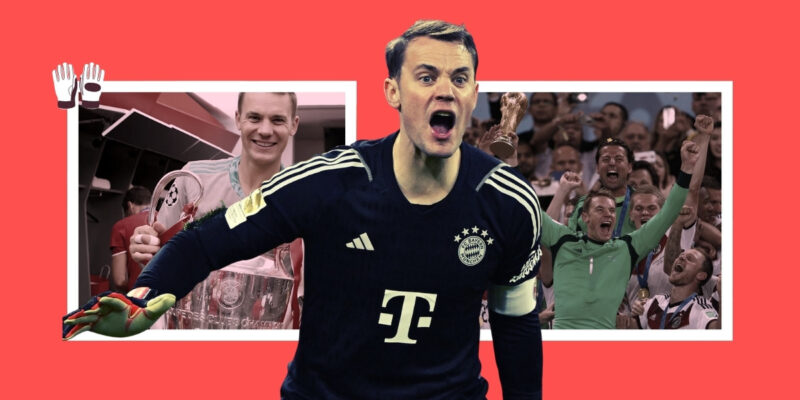
Germany eventually won the game in extra time, but Manuel Neuer was the talk of the town, having touched the ball 59 times, with 21 of those touches occurring outside his 18-yard box.
Some outfield players don’t even average that amount of touches in a season, and a goalkeeper having such numbers wasn’t the norm.
Manuel Neuer achieved what no one had ever done before, and with several remarkable performances throughout his career, like the one he showcased against Algeria, he made his career worth discussing.
Early Life in Gelsenkirchen
Manuel Peter Neuer’s story began in Gelsenkirchen, a city in Germany’s Ruhr area. Before Neuer’s birth, his father, Peter Neuer, transferred as a policeman to Gelsenkirchen with his mother, Marita Neuer.
Growing up in a modest family, he experienced a typical environment where football felt like a joyful activity every young boy would love to partake in.

Like many young boys, Neuer’s earliest dreams were of being an outfield player. He longed to kick the ball hard, dribble past opponents, and score goals that led to passionate celebrations.
His initial preference was to play as a midfielder who dictated play and orchestrated attacks with excellent ball control and passing skills. Contrary to Neuer’s preference, coaches urged him to stay in goal due to his small stature, and he embraced the role.
Before the age of five, Neuer had begun showcasing his talent in goal, and several coaches were impressed with his performances.
Neuer recently spoke about how his decision to play in goal and his parents’ sacrifices influenced his growth.

“My mom replaced the washing machine every two years because my clothes became so dirty from playing on the clay pitch, diving for loose balls, and coming home looking like a dog.”
Every young player seeks an idol to emulate, and for Neuer, that figure was Jens Lehmann. Lehmann was the first-choice goalkeeper for FC Schalke 04 and Germany at that time.
Lehmann was known for his boldness and aggressiveness in goal, and Neuer tried to replicate it in his own way.

Another important figure for Neuer during his childhood was his elder brother, Marcel.
In many ways, Marcel, who later had a career as a professional referee, acted as both mentor and companion. He motivated Manuel to keep pushing and to persevere when faced with challenges and self-doubt.
The Schalke Sensation
Manuel Neuer’s impressive displays at such a young age prompted Schalke 04 to recruit him in 1991. He joined Schalke’s youth setup, the famed Bambinis club, when he was only four years old.
From his first day at the club, it felt like a perfect fit for him. He settled in nicely and hit the ground running. He continued to train and grow under the tutorship of Schalke’s academy coaches, and fourteen years later, he signed his first professional contract.

Neuer’s exceptional talents came to the fore when Schalke promoted him to the senior squad as the first team’s third-choice goalkeeper.
The club’s faith wasn’t misplaced.
On August 19, 2006, Neuer made his Bundesliga debut against Alemannia Aachen after he came in as a substitute for the injured Frank Rost.
He seized the opportunity to announce himself and showcase his talents. Before the next transfer window, he has established himself as the club’s first-choice goalkeeper.
The actual breakthrough, though, came on European nights. The 2008 Champions League clash against Porto remains legendary. I still remember watching that performance unfold.

Neuer pulled off a series of extraordinary saves, and when the game went to penalties, he maintained the solidity to spearhead his team to victory. His brilliance carried Schalke into the quarterfinals, and suddenly the world took notice.
At the same time, Neuer’s tendency to stray from his box caused a stir in Germany after Dejan Stankovic scored a wonder goal against him.
By the 2010/11 season, Neuer had become Schalke’s captain and leader on the pitch. The peak of his Schalke career arrived in May 2011 when he lifted the DFB-Pokal after a thumping 5–0 win over MSV Duisburg.
A few months later, Neuer was named German Footballer of the Year, an award rarely presented to goalkeepers. This accolade felt like a culminating reward for the growth and brilliance shown by Neuer during his time at the Royal Blue.
Big Gloves, Bigger Stage
Manuel Neuer left Schalke 04 in 2011 to join rivals Bayern Munich, a move that sent shockwaves through German football.
As someone who had followed his rise, I knew Bayern were getting the best young goalkeeper in Europe, but even I could feel the tension that surrounded the transfer.
Bayern fans didn’t immediately welcome him with open arms. The rivalry with Schalke ran deep, and many supporters questioned whether a player whose boyhood affiliation was with an arch-rival could ever truly embrace Bayern’s red.

Despite the skepticism and the challenge of proving his value, Neuer showed determination to succeed at Bayern.
The pressure was immense. Bayern is a club with a proud lineage of goalkeepers, from Sepp Maier to Oliver Kahn. Critics wondered if he had the mentality to step into such shoes.
But Neuer did what he had always done best. He answered doubts with performances. He showed composure, awareness, and qualities that silenced critics and endeared the Bayern fans.
OTD in 2011, Manuel Neuer made his debut for Bayern Munich 🔴⚪️
— DW Sports (@dw_sports) August 7, 2025
The rest is history 👑🐐 pic.twitter.com/mJeeag4qRL
His brilliance in goal was superb, and although many doubted his ability to live up to the billing, his performances in his first season were extraordinary.

In his first season, he went over 1000 minutes in competitive games without conceding a single goal. Oliver Kahn previously held this German football record, and by matching the feat, Manuel Neuer silenced any form of skepticism about his ability.
The Sweeper-Keeper Revolution
Neuer’s impact on the sport was not just about his exceptional goalkeeping skills. He revolutionized the philosophy and tactical approach to goalkeeping, shifting the focus from shot-stopping to a more comprehensive role in the team’s defense.
This new approach, often referred to as the ‘Sweeper-Keeper Revolution’, saw Neuer actively participating in defensive plays outside his penalty area, effectively becoming an additional defender for his team.
He changed the perspective with a daring, revolutionary approach, pioneering what we now call the “sweeper-keeper” role. His style bridged the gap between goalkeepers and outfield players, forcing football to rethink what was possible and expected from the man between the posts.

Neuer’s willingness to leave his penalty area redefined defensive structures. While most goalkeepers hesitated on the edge of their box, Neuer charged forward to nullify attacks.
He anticipated long balls and even acted as an extra defender when his back line pushed high. Such an approach to the game was astounding, and watching him implement his style with Bayern and the German national team was impressive.
This tactical innovation changed how managers approached the game. Coaches suddenly had a new option: push their defensive line higher without fearing long balls, because Neuer would be there to neutralize them.

His approach allowed Bayern and Germany to play compact, attacking football while remaining defensively secure. That balance became a blueprint for modern teams—a fundamental block upon which Guardiola built his teams.
It’s no coincidence that, after Neuer’s rise, we saw a wave of goalkeepers expected to be comfortable with their feet, from Ederson to Alisson to Ter Stegen.
The assurance of having a goalie who is excellent at both shot-stopping and ball-playing is what teams now seek when scouting for a goalkeeper.
At the same time, this came at a cost. Any error outside the box was almost a certain goal. Marco Reus followed the Stankovic blueprint when he capitalized on Neuer’s mistake to win a game for Monchengladbach in the Bundesliga.
But this was a one-off. Neuer made up for this with other massive performances.
Golden Gloves and Glory Nights
There is a period where a player reaches the peak in his career, and I can confidently say that for Manuel Neuer, his peak occurred between 2012 and 2013.
The 2011/12 season was a very eventful season for Bayern. They went toe-to-toe with Borussia Dortmund for the Bundesliga title.
Although Neuer was excellent in goal during that campaign, Bayern ultimately fell short, finishing second behind Dortmund.

On the European stage, Bayern played like they wanted to reach a Champions League final hosted in their home stadium.
After topping a group that saw them face Napoli, Man City, and Villarreal, Bayern breezed past FC Basel and Marseille to set up a thrilling encounter against Real Madrid.
When the tie went to penalties, Neuer ensured Bayern secured their ticket to the final. Facing Cristiano Ronaldo and Kaká from the spot, he produced heroic saves that stunned the Santiago Bernabéu.
In the final against Chelsea, Neuer made his presence felt. During the penalty shoot-out, Neuer played mind games to save Juan Mata’s penalty. After showing immense courage to step up and take Bayern’s third kick, which he converted brilliantly, Bayern agonizingly lost to Chelsea.
Then came the unforgettable 2012/13 season. Bayern stormed through Europe, and Neuer stood as the goalie of the side that secured a historic treble—Bundesliga, DFB-Pokal, and Champions League.

Bayern completely obliterated FC Barcelona in the Champions League semifinal, thrashing them 7-0 over two legs.
In the final at Wembley against Borussia Dortmund, he delivered the calm assurance needed on the grandest stage. Neuer stood firm and helped secure a 2–1 victory in a feisty encounter.
His performances silenced all doubts and elevated him into the conversation as not just the best goalkeeper in Germany, but the best in the world.
His Exploits at the 2014 World Cup
Manuel Neuer’s international career with Germany began on a perfect note. He made his debut in 2009 against the United Arab Emirates.
By 2010, with only a handful of caps, Neuer had established himself as Germany’s first-choice goalkeeper heading into the 2010 World Cup.
At the World Cup in South Africa, he displayed maturity well beyond his years, guiding a youthful German side to the semifinals.
His commanding saves against England and Argentina introduced him to the broader world. Still, for fans already following his rise, it was confirmation that Germany had found their guardian for the next decade.
The defining chapter, however, came in 2014. Neuer’s iconic performance in the Round of 16 against Algeria is the stuff of legend.

Time and again, he sprinted outside his box to intercept long balls, clearing danger like a sweeper.
That night, the world saw the full expression of the “sweeper-keeper” role, and he even earned the nickname “Manu der Libero” for his displays during the match. This was the best performance of his international career.
In the semifinal against Brazil, Manuel Neuer was in goal for Germany as they ran riot in that historic 7–1 humiliation of the host.
And in the final against Argentina, he stood tall once more, making crucial interventions and commanding his box with authority. When Mario Götze scored the winner in extra time, Neuer’s heroic saves meant even more as he denied Argentina any chance at a comeback.

At the end of the tournament, he lifted the World Cup and claimed the Golden Glove as the best goalkeeper of the competition.
What followed only solidified his global recognition. In 2014, Neuer finished third in the Ballon d’Or voting, behind only Cristiano Ronaldo and Lionel Messi. It was a remarkable achievement, given how rarely goalkeepers receive such acknowledgment.
Do you realize how out of this world you have to be as a goalkeeper to be close to winning Ballon D’Ors in this era. Manuel Neuer reinvented goalkeeping for decades to come. https://t.co/yWRJLxtwQO
— Xav Salazar (@XavsFutbol) September 5, 2023
Between the Sticks and the Shadows
A few years down the line, Manuel Neuer began experiencing a series of painful and unsettling moments regarding his physical condition.
In 2017, he fractured his foot, which sidelined him for months, stripping him of rhythm and match sharpness. Just as he seemed ready to bounce back to his best, the broken leg he suffered in a skiing accident in 2022 brought yet another cruel twist.

When he did step back onto the pitch after those injuries, the scrutiny intensified. The same media that praised him for his revolutionary exploits now questioned whether he had permanently declined.
His reflexes waned, and his once unshakeable confidence seemed rattled. I remember matches where he looked hesitant to rush out as boldly as before, and critics jumped on those moments, declaring that his famous sweeper-keeper style was outdated and unsustainable.
The most painful aspect for me was hearing respected voices argue that Neuer was past his prime. They claimed his high-risk style had become a liability, and his pace, which enabled him to implement his style of play, seemed to have faded.

Uncharacteristic mistakes, such as rare lapses in concentration or mistimed clearances, were used as evidence that he had finally lost his edge.
Ter Stegen, Bernd Leno, and a host of young German keepers were knocking on the door. It was time for a change.
And in spite of the harsh criticism, Neuer’s determination never faltered. Even when his form dipped or he was not fully fit, his dedication and commitment to Bayern and Germany remained present.
He continued to push himself through recovery and training, refusing to allow injuries or critics to define the final chapters of his career.
The Controversial Sagas
Manuel Neuer, despite his excellence on the pitch and remarkable recovery regarding injuries, has been the centerpiece of several off-pitch controversies in recent years.
These issues did not arise from mistakes on the pitch but from the complex structure of loyalty and politics that inevitably emanated from being the face of Bayern Munich and Germany.
The most shocking moment was when Bayern sacked their goalkeeping coach and Neuer’s close friend, Toni Tapalović. Neuer, still recovering from a long-term injury, did not hide his frustration.

In a heated outburst, he claimed that he felt like “his heart was being ripped out.” While many viewed the outburst as a genuine display of emotions, the Bayern hierarchy has different views on the issue.
Figures like Oliver Kahn openly criticized Neuer, accusing him of putting personal feelings above the interests of Bayern. Suddenly, the media began questioning his professionalism and raised the feeling that he had overstepped.
The controversies spilled into talks about his captaincy at Bayern.
Lothar Matthäus suggested that Neuer’s public stunt was uncharacteristic of a responsible captain and that Bayern should strip him of his captaincy.
The national team offered no refuge from these tensions. When Julian Nagelsmann confirmed İlkay Gündoğan as Germany’s captain, it felt like a stab in the back.

The rivalry with Marc-André ter Stegen only intensified the debate.
In recent years, the debate of who should be Germany’s first-choice goalkeeper has been amplified, especially during Neuer’s period of recovery from injuries. But with these recent issues, the need for such conversations became necessary.
I feel people blew Neuer’s actions way out of proportion, and these issues do not highlight his decline. Instead, they emphasize the immense weight of being the standard-bearer for both club and country.
Comebacks that Define Character
As someone who followed Neuer’s career from his Schalke days, one of his outstanding traits was his resilience. As cliché as this might sound, his ability to perform when the chips are down is nothing short of remarkable.
His journey through broken bones, surgeries, and long months of recovery stands as a testament to my claims.
The metatarsal fracture in his foot that Neuer suffered in 2017 changed the course of his career. This sort of injury sometimes warrants two surgeries, and for any athlete, this can be a significant blow, both physically and mentally.

I remember reading endless debates in the German press questioning whether Bayern should start looking for his replacement. Sven Ulreich was not the answer, but Alexander Nubel was lurking in the shadows.
Yet, Neuer never withered. He helped Bayern secure their second treble in 2020 and their sixth Champions League trophy, keeping a clean sheet in a 1-0 victory over Paris Saint-Germain.

But the most challenging test came in December 2022, when the skiing accident left him with a broken leg. At that point, Neuer was already in his mid-30s, and talks about overall sharpness intensified.
Critics claimed that time had finally caught up with him and that no goalkeeper could come back from such a devastating injury at that age and still perform at the highest level.
Personally, I felt the same way, and understandably so, but I also knew that writing Neuer off had never ended well for his doubters.

The comeback was grueling. For nearly a year, Neuer endured rehab, surgeries, and endless training sessions to rebuild his strength. By the time he regained full fitness and made his return to the starting lineup, it was a great relief.
It was great to see him beat the odds and show that with persistence and belief, a player can still play at a high level after a gruesome spell with injuries.
Life Outside the White Lines
As much as Manuel Neuer is renowned for his performances on the pitch, his impact off the field is just as inspiring.
In 2010, he founded the “Manuel Neuer Kids Foundation”, a non-profit organization dedicated to supporting underprivileged children and teenagers, especially in his hometown of Gelsenkirchen.
Manuel Neuer paid a visit to the kids in his foundation 'Manuel Neuer Kids Foundation' in Gelsenkirchen today. The charity was founded in 2010 and offers support to socially disadvantaged kids [📸 IG/manuelneuer] pic.twitter.com/WktJpmYtzM
— Bayern & Germany (@iMiaSanMia) June 22, 2022
I remember when he appeared on the German version of “Who Wants to Be a Millionaire” and carted home half a million euros for his foundation. These acts highlight the extent of his genuine care and leadership, and the need to give back to the community that helped him grow.

Of course, a player with such class and reputation as one of the world’s best will have brands swarming for his endorsement.
Neuer became the face of several global brands, including Adidas, Coca-Cola, and Head & Shoulders. He also partnered with companies like Allianz and Michelin, to name a few.
Behind all this fame and recognition, Neuer is known for his quiet, reserved disposition; he prefers a more private life.
His legacy, though, extends beyond achievements and endorsements. Whichever way you look at it, Neuer changed football itself.
By pioneering the modern sweeper-keeper role, he pushed coaches and analysts to reassess what a goalkeeper could be. He inspired a new era of goalkeepers who now train with their feet as much as their hands.

But what’s more, Neuer’s approach has reshaped how all players think about responsibility. He showed that if goalkeepers can start attacks, why shouldn’t strikers defend from the front or center-backs create chances in the future?
He expanded the scope of what every position could contribute. To me, football needed a player like Neuer, and his legacy in football would live on.
The Best of Two Goalkeeping Philosophies
When we talk about Manuel Neuer, the question of whether he is an immortal in football history or a figure whom time will render a mortal inevitably arises.
The argument for immortality is compelling. Neuer reshaped the act of goalkeeping and excelled while doing it. Young goalkeepers no longer train solely to save shots. They train to play football because Neuer showed that goalkeepers could be integral to tactics, and not just shot stoppers.
Recently, we have seen how the likes of Andre Onana are excellent with the ball at his feet but terrible at shot-stopping, and David De Gea, who is superb at shot-stopping but terrible at distribution and build-up play. Neuer ensured he was excellent at both being an attacking and defensive goalkeeper.
His trophy cabinet also proves he is up there with the greatest goalkeepers of all time. We can’t overlook his World Cup Golden Glove and title in 2014, the historic treble with Bayern Munich in 2013, multiple Bundesliga crowns, and a collection of individual honors that marked him as the best in the world during his peak.

Yet the case against immortality also carries weight. Football is not judged only by peaks but also by longevity and consistency.
The injuries suffered during his career cost him precious years at the highest level, and critics are reluctant to put him on the same pedestal as legends like Gianluigi Buffon or Iker Casillas.
So where does that leave him? For me, Neuer’s immortality lies not only in his exceptional career but in his transformation of the position. Lev Yashin may have won the Ballon d’Or, and Buffon may have had unmatched longevity, but Neuer left a mark no goalkeeper before him dared to leave.
This revolution puts him in the Mount Rushmore of legendary Goalkeepers.
Who wrote this?

Bienuoma Agaga-Akpati is a software engineer, writer, eSports player, and sports enthusiast, presently working with a group of ambitious Africans to transform the writing industry. With good knowledge of various sports and eSports, coupled with his keen ability for research, he loves analyzing ideas and topics that fosters the growth of the sport and eSports scenes. In his spare time, he enjoys creating content and engaging in discussions across various platforms.
- Bienuoma

- Bienuoma

- Bienuoma
- Bienuoma
- Bienuoma
- Bienuoma

- Bienuoma

- Bienuoma

- Bienuoma

- Bienuoma

- Bienuoma

- Bienuoma

- Bienuoma

- Bienuoma

- Bienuoma

- Bienuoma

- Bienuoma
- Bienuoma
- Bienuoma

- Bienuoma

- Bienuoma

- Bienuoma

- Bienuoma

- Bienuoma

- Bienuoma
- Bienuoma

- Bienuoma

- Bienuoma

- Bienuoma

- Bienuoma