


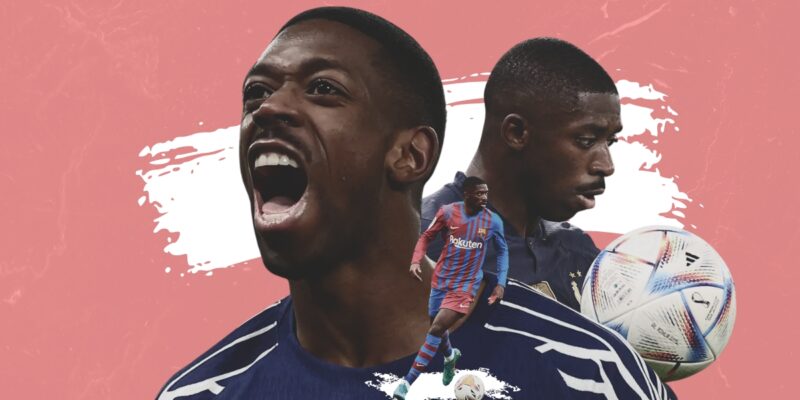
During the absolute demolition of Inter Milan 5-0 in the 2024/25 Champions League final, one man stood at the heart of it all—Ousmane Dembele.
His piercing stare as he stalked Yan Sommer, ready to pounce any time the keeper touched the ball, is now an all-time visual for football fans.
Although Ousmane Dembele didn’t score any goals, he registered two vital assists. With a performance that left even his critics stunned, Dembélé was transcendent.

PSG, for the first time in decades, looked like a complete European force ready for world domination.
But this wasn’t always the story.
Ousmane Dembele’s career has been a rollercoaster, starting off with an early rise to stardom at Rennes and Borussia Dortmund, to a frustrating, injury-riddled spell at Barcelona.
Today, Ousmane Dembele is the 2025 Ballon d’Or winner.
Growing Up in France
Born on May 15, 1997, in Vernon, France, to a Malian mother and Mauritian father, Masour Ousmane Dembele grew up with a little more than a ball, a dream, and a relentless drive to own the spotlight.
In the heart of Normandy, far from the shining lights of Paris, where the youngster now plies his trade, Dembélé grew up in a modest apartment in a culturally diverse neighborhood that saw football, not just as entertainment, but also as an escape.

It was in that neighborhood—where he contested in concrete kickabouts with his friends—that the desire to evolve into a professional football player formed its roots in the hearts of Dembele.
Back then, it was just a carefree pastime. But at such a young age, Dembele saw it as a phase in his journey that would successively turn him into a professional, hopefully a France international like Thierry Henry.

“He stood out a mile. It was almost paranormal: the quality of his sidesteps, his dribbles. You know, a very slender guy with legs like toothpicks, but his dribbling ability was insane.”
– Gregory Badoche
Dembele joined local club ALM Evreux at 7, where his talent stood out among his peers. At the same time, he played consistently in the senior grade. His speed and skill compensated for his physical disadvantage.

The first time Evreux youth coach Gregory Badoche saw him, he couldn’t believe his eyes.
“He stood out a mile,” Badoche recalls. “It was almost paranormal: the quality of his sidesteps, his dribbles. You know, a very slender guy with legs like toothpicks, but his dribbling ability was insane.”
It didn’t take long before major local clubs took interest in him, with Le Havre and Caen both making overtures. Eventually, Stade Rennes won out after offering to help Dembele’s family relocate to Brittany with him.
And for the first time, his family felt the weight of responsibility shift to their budding superstar son.
Breakthrough at Stade Rennais

By the time Dembele joined Rennes’ academy at the age of 12, word had started going around the French scene about his prowess. Coaches couldn’t tell which foot was the dominant or weaker foot.
“I’m two-footed. I prefer to dribble with the left and shoot with the right.”
He’d glide left, strike right, drag the ball back with one foot, flick it forward with the other, a kind of football jazz that was both confusing and hypnotic.
Ousmane Dembele spent six years in the academy, and in the summer of 2015, at just 18, he signed a three-year professional contract.
After making his debut off the bench in a 2-0 win at Angers in October 2015, Dembele became a fixture in the starting XI. His pace was devastating, and his unpredictability was a nightmare for defenders.
He finished his maiden campaign with an excellent return of 12 goals and five assists from 26 Ligue 1 games, capping off a top-notch season with the award of Ligue 1 Young Player of the Year.

Ousmane Dembele had gone from a skinny kid in Vernon who was obsessed with football to an 18-year-old with the world at his feet.
Dembele didn’t just light up Ligue 1; his performance echoed through Europe. And this time, Borussia Dortmund were the first to make the move before the rest could react.
Rapid Rise at Borussia Dortmund
When Dembélé joined Borussia Dortmund in the summer of 2016, he stepped into a high-speed locomotive engine powered by young talents.

The raucous Signal Iduna Park, packed with 80,000 cheering fans. Iconic tifo displays from the Yellow Wall on Champions League nights against Real Madrid and other European giants. A domestic tussle with Bayern Munich—the stuff of dreams.
Under Thomas Tuchel, Ousmane Dembele found himself in a system that gave him the liberty to play his natural game and room to forge a three-pronged attack alongside Marco Reus and Pierre‑Emerick Aubameyang.
He penetrated the hearts of defenses with explosive pace, cutting in and out with both feet, and changing directions faster than the defenders could process.
By the end of the season, Dembélé scored 10 goals and supplied an astonishing 21 assists. But his telepathic link with Aubameyang took centre stage, with 12 of those assists finding the Gabonese striker.

Their combined pace and intuitive interplay became the focal point of Dortmund’s attacking brilliance that season as they became one of the Bundesliga’s most electrifying duos.
For Dembele, that single season in Germany was a statement to the world about his unwavering creativity and off-the-charts potential. His performances attracted interest from several top clubs.
But Dembélé was fixated on a move to his dream team, Barcelona.
He was so hellbent on pushing the move through that he skipped training sessions after the club rejected Barca’s bid—souring his relationship with Dortmund in a way that still lingers today.
Initially, Dortmund responded with a fine and a suspension. But unable to cope with the player’s obnoxiousness, the club gave in to his demands, as he secured a blockbuster move to Spain.
Nightmare at the Camp Nou
When Neymar Jr forced a move to PSG in 2017, Barcelona were in desperate need of a replacement and saw Dembele as the perfect fit.
So when Barca paid a whopping €148 million in 2017, the weight of that task settled heavily on his shoulders.
However, replacing Neymar was never going to be easy, and the first warning signs came early. At his Camp Nou presentation, he failed to juggle the ball cleanly, which was somewhat off for a player of his calibre.
Nonetheless, his debut was promising.
Coming on as a substitute in Barcelona’s 5-0 victory over Espanyol, he assisted Luis Suárez for the final goal, showing flashes of his pace and vision.
However, within two weeks, he ruptured the tendon of his left thigh, which sidelined him for three months.

That marked the beginning of a string of long layoffs that robbed him of the rhythm that defined his game.
Still, there were flashes, including his thunderous right-footed strike against Chelsea in the Champions League and the outrageous chip against Sevilla in the Copa del Rey final. But these moments came in fragments.

“I still have to work on my cardio because I get tired very quickly. At Barcelona, I have a better lifestyle. At Dortmund, I didn’t have a great lifestyle, and I didn’t get injured, so it’s not that.”
His woes didn’t stop at injuries. Even when Dembele was fit, he seemed disconnected, often showing up late and missing medical appointments.
The Final Straw
Fans got fed up and turned him into a punchline—an example of a footballer who would rather spend time in the hospital than face his fears on the pitch.
🎙️[AS] | Dr. Lasse Lempeinen, who operated on Dembele, "This injury is more demanding than the one I operated on in 2017"
— BarçaTimes (@BarcaTimes) February 12, 2020
🔊 Lasse: I'm sure his medical team will manage him well to prevent a relapse. I will track his rehabilitation"
🔊 Lasse: "His best years are yet to come" pic.twitter.com/RVjaGaOCJC
The most defining heartbreak came in 2019, against Liverpool in the UCL semifinal. Barcelona led 3-0 at Camp Nou when Dembélé missed a clear-cut chance to make it four.
At the time, Dembele did not realize the gravity of that miss until Liverpool’s 4-0 comeback at Anfield to crush Barca’s UCL hopes.
Forgive and forget?
— Edmund 2.0💥 (@EdmundOris) July 31, 2023
But truth is I never forgave Dembele for this miss.
I get upset anytime I remember it.
3-0 up against Liverpool, Messi set up the last kick of the game for him to make it 4 -0,
See what your Dembele did:pic.twitter.com/5IxmtxwfoK
Then, the real animosity hit, and his miss felt like a ghost that never stopped haunting the club.
At Barça, Dembélé didn’t just battle defenders; he wrestled with expectation, inconsistency, and the shadow of the player he was signed to replace.
Even though Griezmann, Coutinho, and others struggled to impress during this period, Ousmane Dembele was the scapegoat for the rot that befell the Blaugrana.
The Turning Point Under Xavi

When Barcelona legend Xavi Hernandez returned as a manager in 2021, that was when something truly shifted.
Xavi didn’t just defend Dembele; he saw what others no longer did. “He can be the best in the world in his position,” he said.
Before Xavi’s return, Dembele had played under three managers: Valverde, Setien, and Koeman within the space of four seasons. With the constant managerial changes came a constant switch in his role.
Dembele was primarily used as a right winger, but his role lacked consistency as he was often played on the left wing to accommodate Lionel Messi on the right. Or as a wide forward in a 4-3-3 or 4-2-3-1, but without clear, structured responsibilities.
Xavi’s arrival simplified the chaos, restoring him to a natural right winger in a structured 4-3-3. In return, Dembélé responded with one of his most consistent seasons, dribbling when he needed to, tracking back with grit, and racking up the highest number of assists in La Liga that season, 13.

For once, that felt like the beginning of something.
The noise faded. His injuries became less frequent. His decision-making sharpened. For a while, it felt like he was finally becoming the player the world had been waiting for.

“He can be the best in the world in his position.”
– Xavi Hernandez
With Xavi at his side, those fleeting flashes transitioned into consistent brilliance, and the stats told the story.
But football is not always predictable.
Despite Dembele’s resurgence, a new contract stalled. Barcelona, plagued by financial strain, couldn’t hold on. And just like that, after finally finding rhythm in Catalonia, a departure was imminent.
The Move to PSG

When Dembele arrived in Paris for a €50 million fee, club president Nasser Al-Khelaifi vowed that he would be the homegrown figurehead of a young, hungry team with a strong French identity.
It helped, too, that PSG’s newly appointed coach, Luis Enrique, had been Dembele’s admirer during his time as Barcelona’s coach. Seven years on, their paths finally converged.
“Luis Enrique was fiercely protective of him, right from day one,” said a source close to the PSG coach. “He was confident that he had something magical in his hands and that under him, Dembele was going to flourish.”

After claiming a league and Coupe de France double in his maiden PSG season, Dembele was expected to step up to the plate after Mbappe’s departure that summer. And he did.
The History Makers
It all began with Luis Enrique’s tactical adjustments that would reinvigorate PSG’s season and transform Dembele’s career in December 2024.
“He was confident that he had something magical in his hands and that under him, Dembele was going to flourish.”
The decision to deploy Ousmane Dembele as a false nine sparked a stupendous run of goal-scoring form, which saw him rack up 27 goals in only 22 appearances.
That was twice as many goals as he had ever previously mustered in a season.
By his second season, he was named Ligue 1 Player of the Year.
Then came the Champions League campaign, where he scored a crucial goal in the semifinal against Arsenal to lead PSG to their second-ever UCL final. There, he delivered two assists in PSG’s historic 5 – 0 win over Inter Milan.
Within the space of three months, Dembele orchestrated a victory that PSG’s big-money transfers, Neymar, Messi, and Mbappe failed to do.
Fans who once mocked his missed chances now sing his name. And to complete his redemption arc, Ousmane Dembele, the boy who was once a colossal waste of talent, is now the Ballon d’Or winner.
Dembele with France
Dembele’s journey in the French national team began during his years in Rennes’ youth ranks, where he got his first youth caps at the under-17 and under-18 levels.
His club resurgence permitted him to resurrect his international career. Dembele played only a peripheral role in France’s triumph at the 2018 World Cup in Russia, having lost his place after their opening game.
Due to his struggles at club level, he then went 860 days without playing for Les Bleus between November 2018 and March 2021.

Although injury curtailed his involvement at Euro 2020, his performances with Xavi and now Tuchel were enough to make him a first-choice pick on the right flank at both the 2022 World Cup and Euro 2024.
Ousmane Dembele is already a world champion, but I can’t help but feel he has unfinished business with Les Bleus. After all, he considered a penalty in the first half in their heartbreaking loss to Argentina in 2022.
With his prime fully kicking in, I expect Dembele to play a more prominent role alongside Kylian Mbappe for France at the 2026 World Cup.
Who is the Real Ousmane Dembele?
Dembélé has always been a player of paradoxes: unpredictable and untameable. And perhaps, he was never truly lost at Barcelona, but misplaced.

At one point, the name Dembele was a punchline. Fans scoffed at any mention of his name. Home fans booed him off the pitch whenever he had a bad game.
It doesn’t help that Dembele lacks the maturity, which is no different from young athletes his age.
That racist incident in Japan, where he made fun of Asian technicians on video with Antoine Griezmann, is going to remain a blot on his character forever. One would expect a bit of cultural sensitivity from someone who has been on the receiving end of racial discrimination.
Je me suis toujours engagé contre toute forme de discrimination. Depuis quelques jours certaines personnes veulent me faire passer pour l’homme que je ne suis pas. Je réfute avec fermeté les accusations qui me sont portées et je suis désolé si j’ai pu offenser mes amis japonais.
— Antoine Griezmann (@AntoGriezmann) July 5, 2021
As ill-advised as those racist jokes are, I refuse to join others in crucifying Ousmane Dembele for acting like an ignorant young man.
I’ll focus on the football aspect for now.
Nobody talks about the pressure of massive price tags on teenage shoulders. Nobody talks about the negative impact of homesickness and a lack of support from the organization.

“There you go, we’ve made a whole nation, a whole city proud. And, like they say, the party is just getting started.”
But through it all, Ousmane Dembele has managed to persevere and learn from past mistakes.
After years of stop-start spells, he reinvented himself under Xavi and set his career back on track with the help of Luis Enrique.
Dembele’s resurgence is a reminder that, sometimes, talent doesn’t die; it just needs the right soil to bloom, sometimes right at home.
Who wrote this?

Mahbubat Salahudeen is a Sport Journalist with a primary focus on Youth-Athleticism and women's football.
She is currently pursuing a degree in Media Communications and Public Relations. While much of her experience lies in Sports communications, she has honed transferable skills in strategic communication, audience engagement, and digital media production that transcend industries.
- Mahbubat Salahudeen

- Mahbubat Salahudeen

- Mahbubat Salahudeen

- Mahbubat Salahudeen

- Mahbubat Salahudeen

- Mahbubat Salahudeen

- Mahbubat Salahudeen

- Mahbubat Salahudeen

- Mahbubat Salahudeen

- Mahbubat Salahudeen