




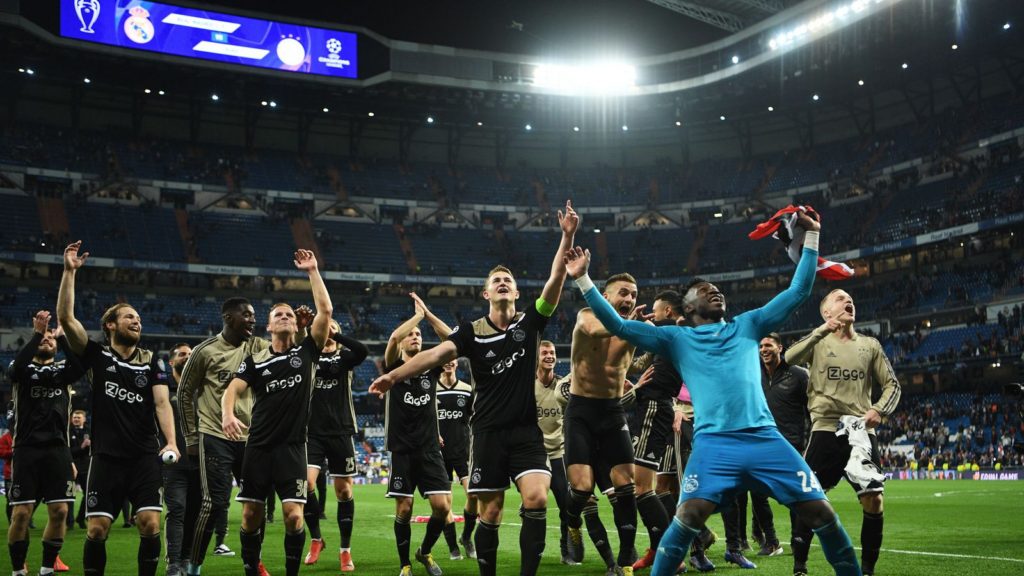
There is a version of football where romance still wins. A version where a club with no summer transfer budget to speak of takes apart Real Madrid on their own turf, sends Juventus home, and comes within a stoppage-time miracle of a UEFA Champions League final.
For one improbable season in 2018/19, Ajax were that romance made real. But the way these stories almost always go, the team that lived it was picked apart piece by piece.
Seven years on, the Ajax Class of 2019 is scattered across four continents and multiple leagues. Some are still winning things while some are fighting relegation battles in leagues nobody covers. This is where they all ended up.
The Season That Shouldn’t Have Happened
Ajax started the 2018/19 campaign as an afterthought on the continental stage. They’d gone through the playoffs to reach the Champions League group stage, having finished second, four points behind PSV Eindhoven in 2017/18.
Ajax put Sturm Graz aside 5-1 on aggregate in the Second Qualifying Round before scoring five in two legs against Standard Liège in the Third Qualifying Round. A 3-1 aggregate victory over Dynamo Kyiv in the playoffs secured their spot in Group E alongside Bayern Munich, Benfica, and AEK Athens.
Ajax was equally impressive in the group stage games. They didn’t lose a single game, winning three and drawing three, including an entertaining 3-3 draw with FC Bayern. A victory in that game would have secured first place for Ajax, and they were close, leading 2-1 until the 87th minute. However, a fightback from FC Bayern and a late Nicolás Tagliafico equalizer meant both teams settled for a draw. Ajax finished second and was rewarded with a clash against defending champions, Real Madrid. But we will come back to that in a while.
Domestically, Ajax’s story had actually begun with disappointment, a year earlier. Ajax finished the previous season as runners-up for the fourth straight campaign, and Erik ten Hag, appointed midway through the season, did well to stabilize the ship.
One particular decision that proved pivotal was the appointment of a captain. Following an injury to skipper Joel Veltman in March 2018, Matthijs de Ligt was named permanent captain. At the age of 18, he became the youngest permanent captain in the history of AFC Ajax.
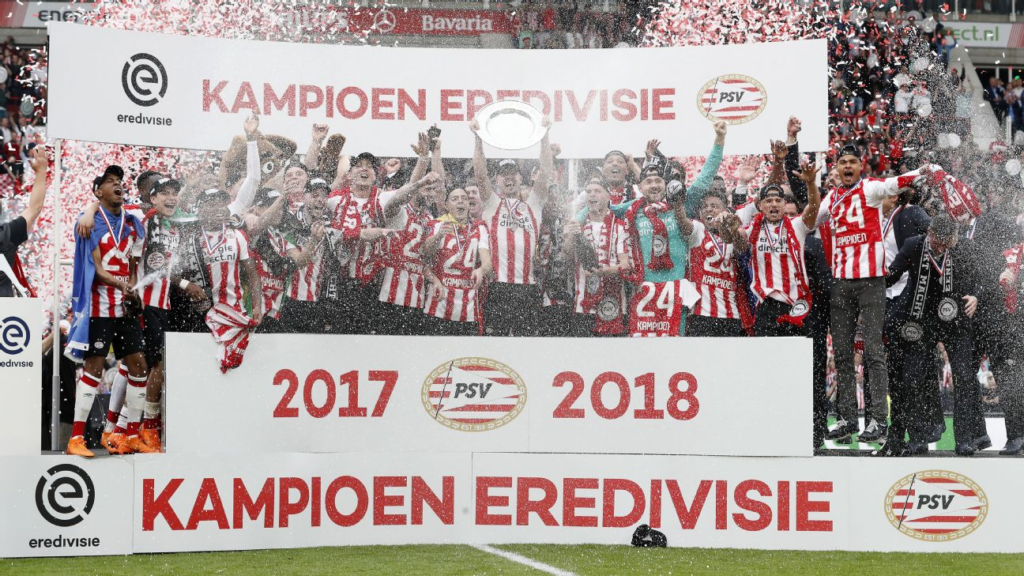
Ajax opened the league campaign with a rather disappointing 1-1 draw with Heracles Almelo at home but bounced back with four straight wins. On Matchday 5, an all-too-familiar foe, the defending champions and league leaders PSV, hosted Ajax. PSV won comfortably 3-0, with all goals coming before the 40-minute mark.
The response was, again, swift as Ajax went on an 11-game winning streak, putting eight past De Graafschap in December without reply. By the turn of the year, they were locked into a title race with PSV that would run the full distance.
A 4-4 draw with Heerenveen and a 6-2 thumping at Feyenoord slightly dented their momentum. They got the momentum back with a 6-0 thrashing of VVV-Venlo before losing the next match, 1-0, at Heracles Almelo. The good news was the fact that PSV were also dropping points. Between the start of the second half of the season and the end of February, PSV drew four of the six games played.
The two sides traded blows for months, and they met again on matchday 27 at the Johan Cruyff Arena. Ajax got their lick back this time, winning 3-1 to move closer to the league leaders. And on matchday 29, after 24 straight matchdays in second place, Ajax leapfrogged PSV into the top spot. And they did not let go. They won all games, failing to score at least four goals in only one game.
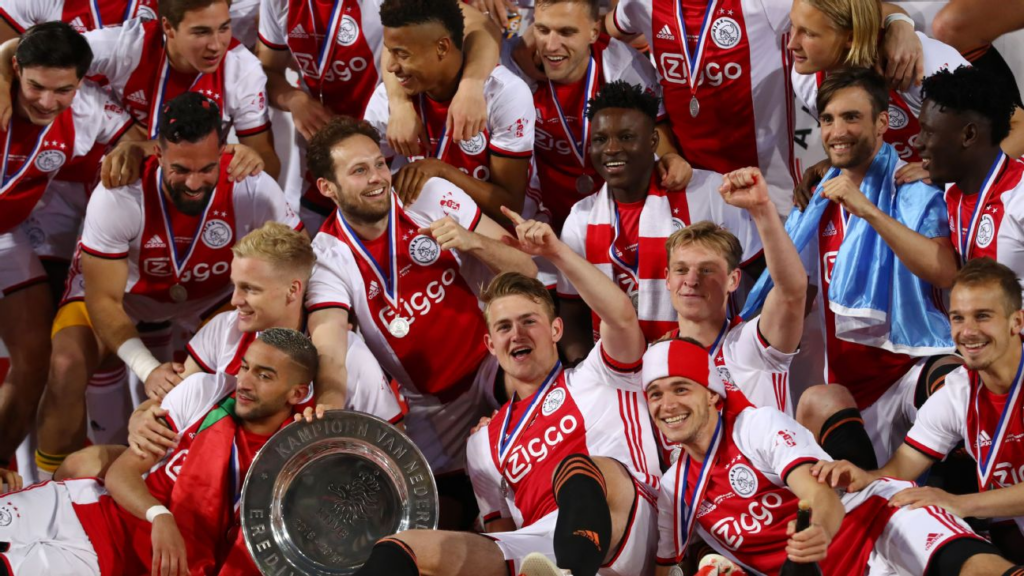
On May 15, 2019, needing a win to guarantee the championship regardless of what PSV did elsewhere, Ajax traveled to a relegation-threatened De Graafschap and won 4-1. Twenty-eight wins, two draws, four defeats, 86 points, and 119 goals scored. Their first Eredivisie title since 2013-14.
Ten days earlier, they had wrapped up the other half of the double: a 4-0 demolition of Willem II in the KNVB Beker final at De Kuip.
This was Ajax’s first domestic double since 2001-02, and their first cup win since 2013. A squad of academy graduates and bargain signings was sweeping the board at home, and in Europe, they had pulled off an incredible upset in the midst of all this.
The Brink of The Unimaginable
Ajax went into the Champions League Round of 16 against defending champions Real Madrid as clear underdogs. The first leg in Amsterdam went Real Madrid’s way 2-1, and no one batted an eye, as that was an expected outcome. In some ways, the fight shown by Ajax was praised as they looked to get a draw after Ziyech canceled out Benzema’s opener. But a late winner from Marcos Acensio was a real kick in the teeth.
Ninety minutes at the Bernabéu, they say, is long. The return proved to be a long night, but not for Ajax. Seven minutes into the game, Ziyech found the back of the net, and one goal quickly became two when David Neres scored in the 18th minute. Dušan Tadić, who had assisted both first-half efforts, added a thumping third just past the hour to leave Madrid with a mountain to climb.
Madrid hit the woodwork through Raphaël Varane and Gareth Bale, and when Asensio scored in the 70th minute, it sent a signal of hope to a stadium that had witnessed incredible comeback victories.
However, that hope was extinguished very quickly. Two minutes later, Lasse Schöne scored, curling in directly from a free-kick wide on the left. 4-1 victory on the night and 5-3 on aggregate on the turf of the champions that had dominated the competition for three straight years.

The quarter-final brought Juventus and arguably the greatest player in Champions League history, Cristiano Ronaldo. Like clockwork, Ronaldo proved his proficiency as he nodded home on the stroke of half-time in the first leg in Amsterdam. But, immediately from the restart, Neres bent one in from the edge of the box to level the scores. The game ended 1-1, and quite frankly, Ajax maybe deserved more in a match they dominated.
Again, Ajax were not favorites for the return leg in Turin. They were up against a team that wanted to win the Champions League so badly that they got Ronaldo in their ranks. And it was that man again, Ronaldo, who scored first in the 28th minute. At this point, the expectation was that Juventus would see out the game and book their place in the semi-finals.
But Ajax did not roll over; they rolled their sleeves up and showed their mettle. Donny van de Beek equalized in the 34th minute, and young captain de Ligt powered a header in with three-quarters of the game gone. Ajax won 2-1 (3-2 on aggregate), and the only criticism of ten Hag’s team was that they could have scored more.
Let’s not lose track of the fact that while Ajax was ousting European giants, they were locked in a title race with PSV. When they beat Madrid, Ajax were two points behind PSV, and they were level on points after the Champions League quarter-final.
By the time the semi-final came around, Ajax were at the top of the Eredivisie. But English outfits, Tottenham Hotspur among them, were eyeing records of their own. It was Tottenham’s first European Cup semi-final in 57 years, since losing to eventual winners Benfica in 1962.
In the first leg in London, it was an advantage for Ajax after van de Beek’s early away goal earned a slender lead ahead of the second leg. Ajax’s slick passing rattled Tottenham from the first whistle, and Van de Beek rounded off a lovely flowing move with a calm finish.
The result meant that Ajax did not lose a single European away game in 2018/19, but their home record was a cause for concern. Before the second leg, they were on a run of seven home games without a win in UEFA Champions League knockout phase matches.

However, by halftime in the second leg, no one remembered this record, and Ajax had a foot and four toes in the UEFA Champions League final. As early as the 5th minute, De Ligt headed in from a corner, and ten minutes before half-time, Van de Beek and Tadić combined to set up Hakim Ziyech for a fine first-time finish. 2-0 on the night and 3-0 on aggregate, Ajax were in party mode, and Tottenham needed a miracle.
That miracle happened. Ten minutes after the restart, Lucas Moura raced through on goal and pulled one back for Tottenham. Just four minutes later, after a defensive error, Moura again found the ball at his feet and danced past defenders to get a shot away to make it 2-2 on the night and 3-2 on aggregate. As things stood, Tottenham needed just one more goal to win the whole tie based on the away goals rule.
The final thirty minutes were frantic, and with both sides committed to attack, chances continued to flow. Ziyech had a 20-meter shot come back off the post while Jan Vertonghen struck the crossbar. But with seconds remaining on the clock and looking as if Ajax would resist, Moura swept into the net, completing his hat-trick and a comeback for the ages.
From an Ajax point of view, it was a cruel end to a European run like never before. Ajax became the first side in European Cup history to reach the semi-finals, having come through three qualifying rounds. A record that probably deserved a sweeter ending that we don’t always get in football.
They regrouped in time to seal the league title one week later. It remains, to date, the last time Ajax has been genuinely and unambiguously the best team in the Netherlands and one of the best teams in Europe in the same season. What followed the summer after was almost inevitable as the vultures came for the architects, one by one.
The Starting XI: Where Are They Now?
André Onana (GK)

André Onana played 55 times (including all 18 Champions League games) and was more than just a shot-stopper that season; he was fully in ten Hag’s system. He was functionally an outfield player in gloves, comfortable enough on the ball to receive passes under pressure inside his own box and start attacks that other keepers would not dream of attempting. That comfort in possession became his calling card and, eventually, his ticket out of Amsterdam.
He left for Inter Milan on a free transfer in 2022, where his sweeper-keeper instincts fit Simone Inzaghi’s high defensive line perfectly. He won the Supercoppa Italiana and Coppa Italia that season and was in goal in the UEFA Champions League final against Manchester City.
City rivals Manchester United paid roughly €50 million for him in 2023, believing they were solving a goalkeeping problem that had plagued the club for years. However, after a string of high-profile individual errors, several of which directly cost points in high-pressure matches, Onana became one of the most scrutinized goalkeepers in the Premier League.
Two years later, Onana was replaced by Senne Lammens, a signing from Belgium’s second tier, while he went out on loan in Turkey. Onana is now in his second consecutive season on loan at Trabzonspor, where he’s rebuilt some credibility with 34 appearances in his debut season and a Turkish Cup winner’s medal. However, there’s no obvious route back to Old Trafford, and his contract there still has two years to run with no clear plan for either side.
Noussair Mazraoui (RB)

Noussair Mazraoui broke into the first team that season as an athletic, attacking right-back who thrived in ten Hag’s high-possession structure. Mazraoui was constantly overlapping and contributing directly to Ajax’s chance creation from wide areas. He was a modern full-back in the truest sense, years before that became the position’s default job description everywhere.
He followed the well-worn Ajax-to-Bayern pipeline in 2022, winning the Bundesliga in his first season in Munich, before joining Manchester United in 2024 alongside his old Ajax and Bayern center-back partner, Matthijs de Ligt. Of all the Class of 2019 members who ended up at Old Trafford, he has arguably adapted best to the chaos of the Ten Hag-to-Amorim-to-Carrick managerial merry-go-round.
Mazraoui has been deployed across right-back, left-back, center-back, and even as an auxiliary number ten by successive managers trying to solve United’s structural problems, and he finished second in the club’s Players’ Player of the Year vote. He remains a fixture for Morocco, occupying a flexible defensive role at the 2026 World Cup as the Atlas Lions build on their historic 2022 semi-final run.
Matthijs de Ligt (CB)

No player’s career better illustrates the gap between potential and outcome. Matthijs de Ligt was the youngest captain in Ajax’s history. In 2018/19, he had as massive an individual storyline as any of his teammates. His header eliminated Juventus in the quarter-final, his composure helped dismantle Real Madrid at the Bernabéu, and it was all capped by winning the Golden Boy award as Europe’s best young player.
Juventus paid roughly €75 million for him that summer in a deal many assumed would be the first of several superclub moves for a defender many considered the best of his generation. But it didn’t work as advertised. Three years of inconsistency in Turin followed, undermined by tactical mismatches and a defensive unit that never fully suited his game.
Then, Bayern Munich took a chance on him in 2022, and he won a Bundesliga title in his debut season before settling into a more convincing rhythm. However, he never quite nailed down an undisputed status ahead of Bayern’s other options.
Manchester United signed him in 2024, reuniting him with the manager who made him captain at 19, Erik ten Hag, but that reunion fell apart very quickly. Ten Hag was sacked within months of de Ligt’s arrival, and de Ligt’s own campaign disintegrated due to a persistent back injury that eventually required surgery after six months of unsuccessful conservative treatment.
His last match was in November 2025, and he was ruled out of the 2026 World Cup entirely and will also miss the start of the 2026/27 season. This absence has a brutal, avoidable feeling for a player once assumed to be a regular fixture of Dutch squads well into the 2030s.
Daley Blind (CB)

Daley Blind has probably the strangest and, in its own way, most satisfying arc of the entire 2019 squad, mostly because there are two full loops in it rather than one. He was already an Ajax veteran and returned like a prodigal son in 2018, after a four-season stint at Manchester United.
Blind started 57 of Ajax’s 58 games that season, and the only game he missed was the first round of the KNVB Beker. His experienced head alongside a teenage de Ligt marshaled a back line that included players a decade his junior. His reading of the game and left-footed passing from the back gave Ajax’s build-up an extra layer of control that younger center-backs couldn’t have provided on their own.
He stayed at Ajax for two more title-winning campaigns before a free transfer to Bayern Munich in January 2023, a short, unremarkable stint that ended after just five appearances.
Girona picked him up as a free agent later that year, and he experienced a genuine career revival: three seasons as a mainstay of Girona’s financially-doped fairytale La Liga campaigns, including a Champions League qualification run that took him back to the group stage in his mid-thirties.
Then, in July 2026, at 36, Daley Blind went home again. He signed a one-year deal for a third spell at Ajax, this time not as the elder statesman guiding teenagers but as a genuine veteran presence in a rebuilding squad that badly needs one. Only a few players from that era have taken a longer or stranger road back to exactly where they started.
Nicolás Tagliafico (LB)
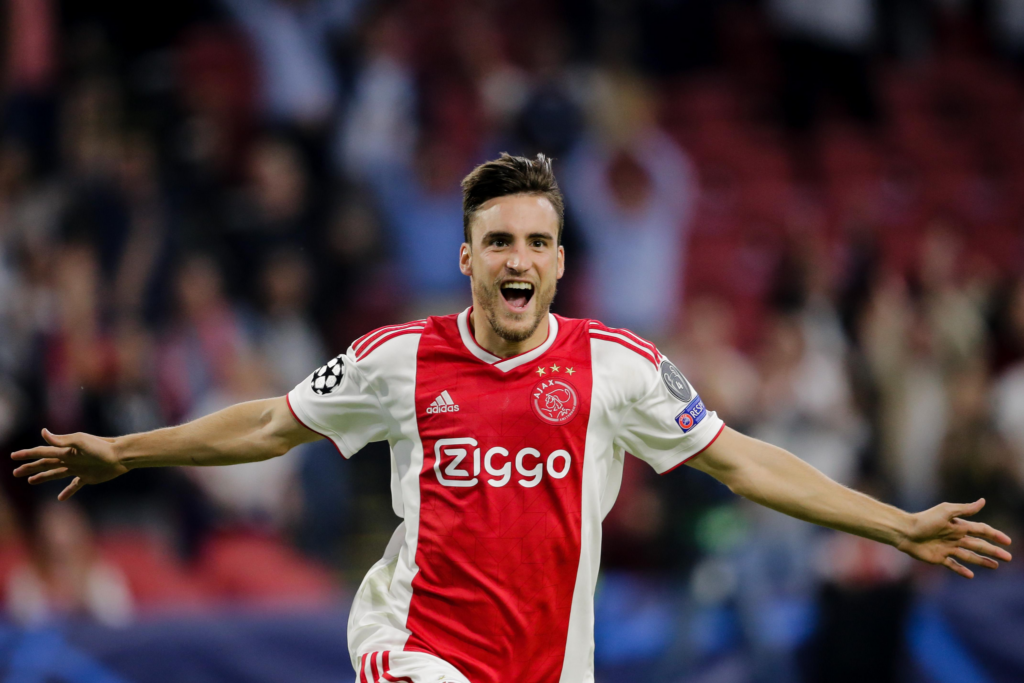
Argentine left-back Nicolás Tagliafico was one of the unsung engines of the entire European run and one of the campaign’s genuine breakout stars in his own right. Tagliafico scored twice on his Champions League debut against AEK Athens, then netted a crucial late equalizer against Bayern Munich in December that kept Ajax’s unbeaten group-stage run alive.
He was named Eredivisie Player of the Month for November 2018 and scored in the title-clinching win at De Graafschap, a fitting final contribution to a season in which he barely missed a match across three competitions.
Tagliafico stayed at Ajax three years longer than most of his teammates, departing for Lyon in 2022, the same year he won the World Cup with Argentina. He continues to be a mainstay for Lyon, still a regular starter in his thirties and good enough to be Argentina’s first-choice left-back, featuring at the 2026 World Cup as one of the squad’s senior professionals.
Lasse Schöne (DM)

In the 2018/19 season, Lasse Schöne was already 32 years old. He was a veteran and a fan favorite for his set-piece delivery and calm distribution from deep. His free-kick opened the scoring in the title-clinching win at De Graafschap, and he scored from a direct free kick to seal the memorable victory at the Bernabéu. He left for Genoa that same summer, part of the natural thinning-out of an aging core.
It didn’t work out in Italy, and Schöne drifted back to the Netherlands within a couple of years. First, he returned to Heerenveen, before heading back to NEC Nijmegen, the club where his Dutch career was established before Ajax ever came calling.
He spent four seasons there as a senior and dependable presence for a club rebuilding its own identity, before retiring in July 2025. His career ended up defined more by loyalty, longevity, and craft. The trophies he won, however, he won as a starter, not a passenger.
Donny van de Beek (CM)

This is, perhaps, the most painful individual story of them all. Donny van de Beek was Ajax’s most complete midfielder that season. He had a box-to-box presence and a knack for arriving late into the box, yielding crucial goals throughout the campaign, including the opener in the first leg against Tottenham in London. At 22, he looked like the most complete package of any of Ajax’s academy graduates: technically composed, tactically intelligent, and clinical in a way that suggested a long career at the very top.
Manchester United paid £39 million for Van de Beek in 2020, a fee that reflected genuine excitement about what he could become. The interest around him was particularly high, and Real Madrid was interested before United swooped in, but he barely played for the Red Devils.
Buried behind established midfielders and never given a settled run in his best position, his confidence visibly eroded season by season, and loan moves to Everton and Eintracht Frankfurt did nothing to revive him. By 2024, United let him go to Girona for a reported €500,000; from £39 million to under half a million says everything about what four years at Old Trafford did to his career.
At Girona, he has only played 28 league games in two years, having suffered an Achilles tendon rupture in September 2025. He has also not played for the Netherlands since 2021. He’s not even yet in his 30s, and he is still searching for even a fraction of the level that once made him one of the most coveted young midfielders in Europe.
Frenkie de Jong (CM)

Of the academy graduates, Frenkie de Jong is the one whose stock never truly fell, and it’s worth remembering just how central he already was in 2018/19, before Barcelona’s interest became public knowledge in January 2019.
De Jong was the deepest of Ajax’s midfield three, the player through whom both full-backs and center-backs funneled possession. His performance at the Bernabéu against Real Madrid, pulling the strings against a midfield featuring Toni Kroos and Luka Modrić, remains one of the best individual displays of that Champions League campaign. He capped the season by winning the Johan Cruyff Trophy as the Eredivisie’s best young player, the third Ajax player in as many years to take the award.
Frenkie De Jong completed his move to Barcelona that summer for around €86 million and has remained a first-team fixture there ever since, approaching 200 appearances, set to be the first-team’s primary captain, and his contract runs till 2029.
He’s not been without frustration, though, as injuries have interrupted several campaigns, including a serious ankle problem that cost him Euro 2024 entirely. The latest setback arrived at the worst possible time as he suffered a torn MCL while playing through pain at the 2026 World Cup.
Hakim Ziyech (RW)

Hakim Ziyech’s post-Ajax career reads like two different stories stitched together, and it’s easy to forget just how spectacular his form was in 2018/19 before that split occurred. He scored 21 goals and provided 21 assists across all competitions. His combination of a wand of a left foot and genuine end product made him arguably Ajax’s most feared individual attacker that year (alongside Tadić).
Chelsea paid roughly £33 million for him in 2020, and won the Champions League in 2021. But he never became the week-to-week creative force his Ajax form had promised, drifting in and out of successive managers’ plans. Spells at Galatasaray and Qatari side Al-Duhail followed, each shorter and less convincing than the last, and it felt like a career slowly running out of runway.
Then, in October 2025, Ziyech made an unexpected move. He turned down interest from La Liga side Sevilla and signed for Wydad Casablanca. His primary motivation was to play football in Morocco and reconnect with his ancestral roots. And in his first twelve league games, he found the back of the net eight times. Not the career arc anyone predicted in 2019, and not without its own physical setbacks along the way, but definitely not a sad one either.
David Neres (LW)

David Neres was the youngest attacking piece of that front line; a Brazilian winger signed from São Paulo whose dribbling and pace gave Ajax a different kind of attacking threat than Ziyech’s guile on the opposite flank. He remained at Ajax for three more years, developing into one of the Eredivisie’s most productive wide players.
He departed in early 2022 for Shakhtar Donetsk before the move disintegrated weeks later following the Russian invasion of Ukraine. Benfica, then, gave him a genuine platform to rebuild, and he thrived there, winning a domestic double in his debut season in Portugal
In 2024, Napoli signed Neres, and the move spectacularly paid off once again. He won a Serie A title in his first season under Antonio Conte and the Supercoppa Italiana the following season, scoring a brace in a 2-0 win over Bologna.
Dušan Tadić (ST)
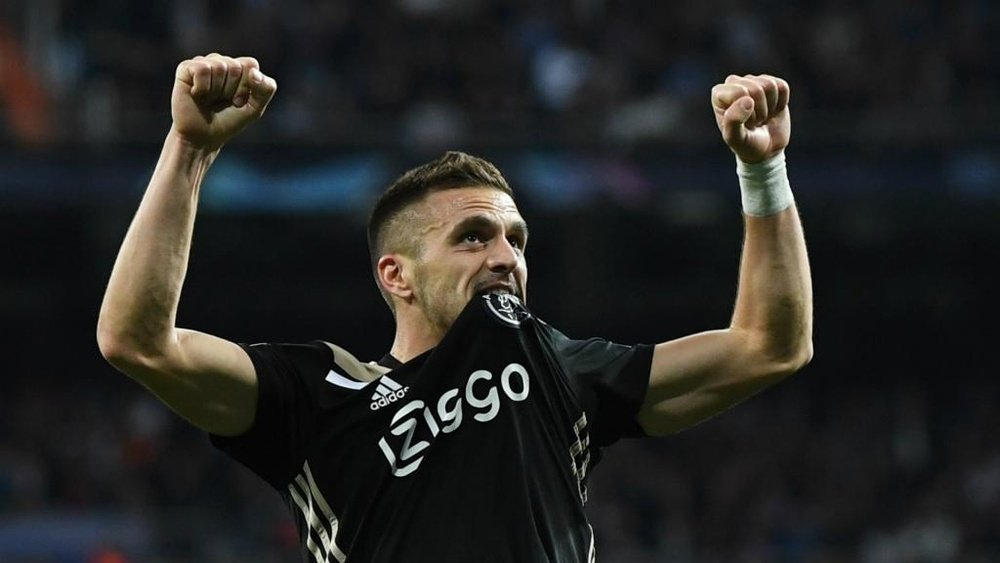
Dušan Tadić joined from Southampton for €11.4 million, a fee most of the Premier League considered a steal, and he was the emotional and statistical heart of that entire campaign. He was the club’s top scorer with 38 goals. He shared the Eredivisie’s golden boot with PSV’s Luuk de Jong, who also scored 28 goals in the league.
Tadić was expected to play as a wide forward, but Ten Hag’s decision to redeploy him as a deep-lying false nine was the single tactical adjustment that unlocked Ajax’s attack that season. He scored important goals all through the campaign, including a brace in the title-sealing win at De Graafschap, and by any measure was the difference-maker across both domestic trophies.
He stayed at Ajax three years longer than almost anyone else in this XI, wearing the captain’s armband through a period of considerable squad turnover, before finally leaving for Fenerbahçe in 2023. Two productive seasons in Turkey yielded 64 goal contributions in 109 appearances across all competitions. A year at Al-Wahda in the UAE followed his exit from Fenerbahçe, and he scored 25 goals in just 42 appearances.
Then, in July 2026, at 37 years old, Tadić signed a two-year deal with NEC Nijmegen. A move that brought him back to Dutch football just as NEC aimed for Champions League qualification off the back of a stunning third-place Eredivisie finish last season, their best in years.
It’s a fitting final act, one he’s reportedly already begun planning to follow into coaching. The arrow of Ajax’s great romantic run, closing out his playing career, chasing one more shot at Europe’s biggest stage, in the country where it all started.
The Manager: Erik ten Hag’s Long Way Home

No figure is more inseparable from that season than Erik ten Hag. He got the job in December 2017 after Marcel Keizer was dismissed, and he was clearly a young manager on the rise. Erik ten Hag had guided FC Utrecht to back-to-back European football playoff rounds, and when he left for Ajax, Utrecht were in 6th place. At the midway point of the season, Ajax had already been eliminated from the KNVB Beker, as well as the qualifying rounds of the Champions League and Europa League. It felt like a gamble that might pay off in a couple of years, if the Ajax hierarchy gave it enough time.
Instead, Ten Hag built the entire structure that carried them to the double and the Champions League semi-final the following season. The aggressive pressing, trust in academy graduates over marquee signings, and the positional discipline that let a nineteen-year-old center-back captain the team were all engineered by him. It remains one of the most complete coaching jobs of the last decade of European football, made all the more remarkable by how young and inexperienced the group he was working with actually was.
Just like they did for several Ajax players of the same class, Manchester United came calling in 2022. The hope was that Ten Hag could replicate his model in the Premier League with considerably more resources at his disposal. But it was never really consolidated. He came close at moments, as an FA Cup win in 2024 briefly bought him time and validated the appointment. However, United’s underlying results never matched the highlight reels, and a collapse the following season led to his sacking.

In July 2025, Ten Hag succeeded Xabi Alonso as Bayer Leverkusen head coach, but he did not last in the job. He allegedly employed unusual tactics, such as prioritizing push-ups over running and passing.
According to reports, he also repeatedly clashed with upper management over player transfers by only suggesting players from his own agency, SEG. After losing the opening game of the season 2-1 at home to Hoffenheim and a 3-3 draw against Werder Bremen, despite leading 3-1, Ten Hag was sacked.
In February 2026, ten Hag returned to Dutch football. He returned to FC Twente, the club that made him and gave him his first taste of senior football. His return, however, was not to football management. He was appointed as the team’s Technical Director. A quieter role than the one that made him famous, working from the boardroom rather than the touchline. He will be shaping recruitment and structure rather than issuing instructions from the technical area.
But there’s a symmetry to it that fits the theme of this whole story. After nearly a decade chasing bigger stages, on bigger budgets, with bigger expectations, the coach who built Ajax’s great romantic run has gone home too.
Ajax Now: The Comedown
The club these players left behind has spent the years since searching for a way back to that level, and it has been largely unsuccessful. The 2025/26 season captured the drift as starkly as possible. John Heitinga, promoted from the reserves to the top job after a playing career that spanned over 150 games for Ajax, was sacked in November 2025. Academy coach Fred Grim took over as caretaker and lasted barely four months. He oversaw just nine wins from twenty-one games in a spell that started with three straight defeats.
Óscar García, a Spaniard with previous head coaching spells across Europe, was brought in to see out the campaign as Ajax’s third head coach of the season. They finished fifth in the Eredivisie, twenty-four points off champions PSV. That gap would have been unthinkable to the squad that finished three points clear of the same rivals in 2019. They were eliminated from the KNVB Beker in the Round of 16 following a heavy 6-0 defeat away at AZ, and that stood as arguably the lowest point of a genuinely abysmal season.

European qualification for the 2026/27 season will have to be salvaged through a playoff round, as they enter the second round of the Europa Conference League. It reads as a state of affairs that would have seemed almost unimaginable to the club that went unbeaten through a Champions League group containing Bayern Munich seven years earlier.
It’s a pointed footnote, and one that captures the whole arc of this story better than almost anything else could, that Tadić’s new club, and Schöne’s old one, NEC Nijmegen finished in third place last season and now enters Champions League qualifying while the club that made both of those players legends rebuilds from outside the continent’s top table.
The romance of 2019 has not been replicated since, by Ajax or, in truth, by very much of European football. Some journeys from that squad end in triumph, while some end in injury and heartbreak. A couple, remarkably, end exactly where they began: wearing the same shirt, in the same stadium, old enough now to be mentoring the teenagers who might one day do it all again.
Who wrote this?

Philip is a sports broadcaster at Royal FM 95.1 in Ilorin, Nigeria, where he presents Sport File and Soccer Chat. Away from the mic, he writes long-form football pieces and runs Football Chronicles on YouTube. He has worked with AFTV, Kwara Youth League and Koller FA. He's interested in the stories behind the results — why teams rise, why they fall, and what gets forgotten in between.