



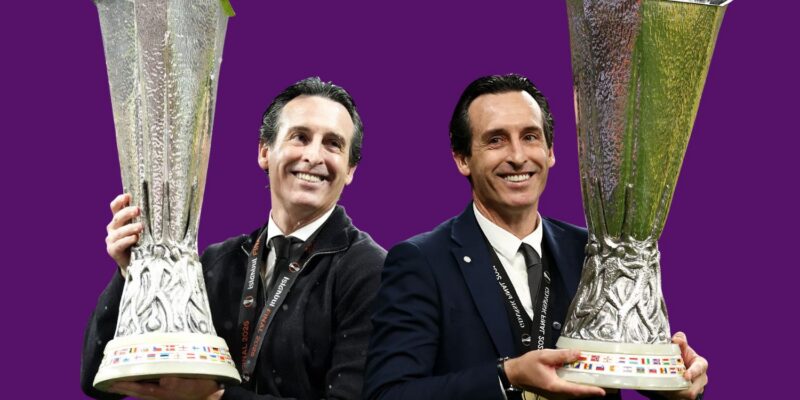
When the referee blew the final whistle on May 20, 2026, the Aston Villa fans in the stadium, who had been celebrating for the better part of half an hour, let out a roar of victory. That roar signaled they had won the UEFA Europa League, ending a 30-year wait for silverware. For Aston Villa, it was a night of catharsis. For manager Unai Emery, it felt more like routine.
This was Unai Emery’s fifth Europa League title win across 12 years. That is dominance on a different level, given the fact that Europa League winners played in the Champions League the next season. No other manager comes close, and even Giovanni Trapattoni won 3 titles with Juventus and Inter Milan in 16 years.
So how did Emery become a dominant force in a tournament regularly dismissed as European football’s consolation prize? How on earth did he win three in a row?
This is the story of “Mr. Europa League,” Unai Emery.
Playing Career & Managerial Start
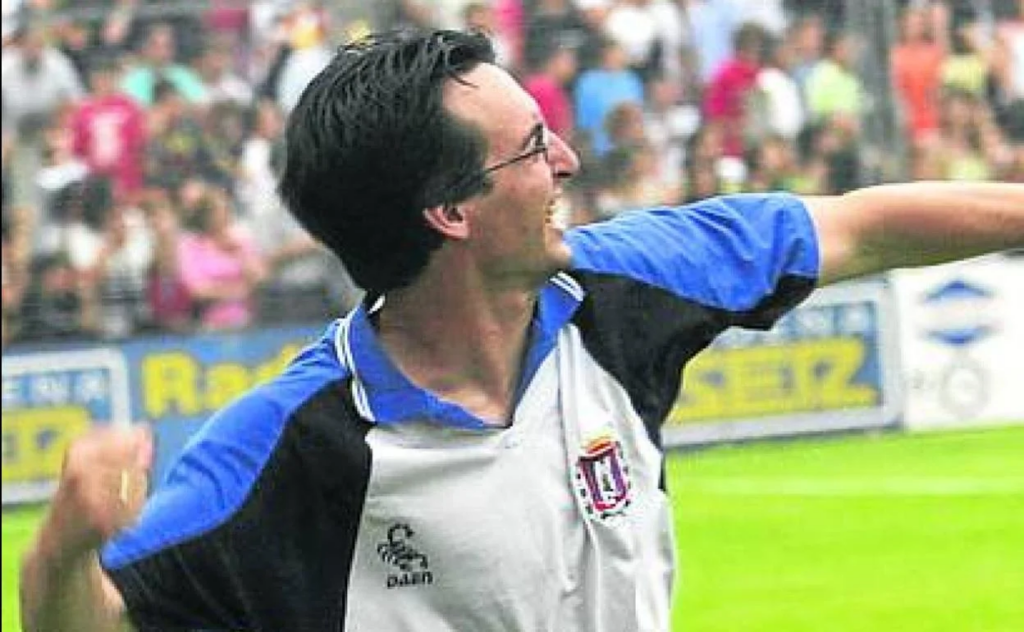
Unai Emery was born in Hondarribia, Spain, into a footballing family. He played as a left-sided midfielder and graduated from Real Sociedad’s youth system but managed only five La Liga appearances before dropping into the lower leagues.
After a career spent mostly in the Segunda División, Emery retired with Lorca Deportiva at 32, after one season in Segunda División B, following a serious knee injury. This disappointment, however, opened the door to management. The club president offered him the vacant coaching position, and he wasted no time making his impact felt.
He secured promotion with Lorca Deportiva to the second division for the first time in its history, and he was recognized for his tremendous work that season, subsequently winning the Miguel Muñoz Trophy as coach of the season.
Emery began establishing himself as a young manager, moving to Almería in the Segunda División and helping the team secure a first-ever promotion in 2007, finishing eighth in their first La Liga season. Almería, in particular, put him on the radar of Spain’s bigger clubs, and in 2008, Valencia came calling.
The Valencia Foundation (2008–2012)
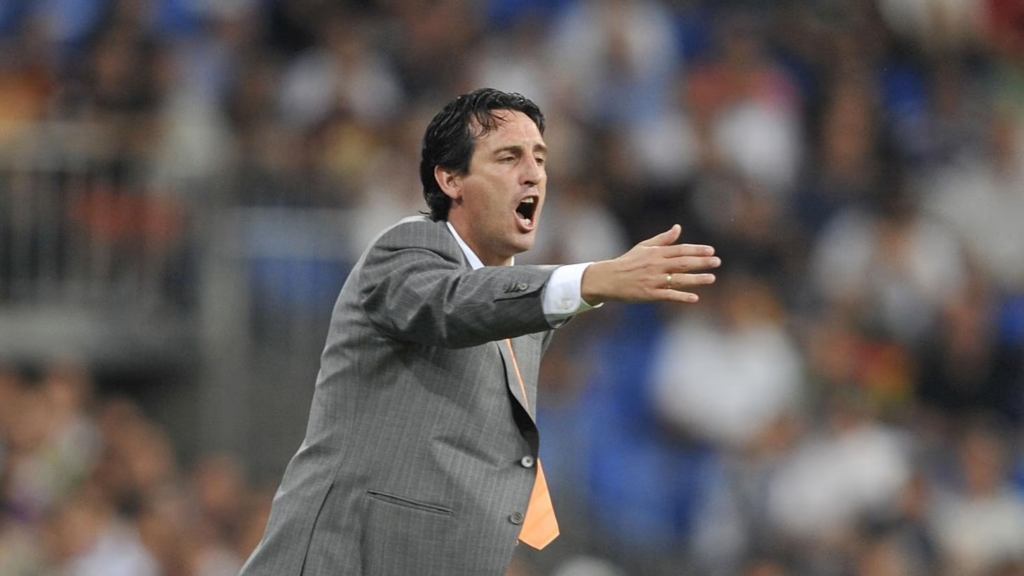
In 2008, Valencia were at the start of a financial crisis—they seem to be in financial crises a lot these days—but the expectation of competing for major honors remained. The only issue was their budget. Even so, this was a good environment for Emery to start building the identity that would define his career.
Emery inherited a strong squad with a core of Spanish internationals: David Silva, Ruben Baraja, Fernando Morientes, David Villa, Juan Mata, and captained by Carlos Marchena and Raul Albiol. He finished 6th in his first season, reached the quarter-finals of the Copa del Rey, and progressed to the knockout stages of the UEFA Cup.
By the 2009/10 season, Emery finally built his perfect team. In the Europa League, Valencia topped their group unbeaten, with 12 points from matches against Lille, Genoa and Slavia Prague. In the Round of 32, they overturned a 1-0 away defeat with a 3-0 home win to eliminate Club Brugge, and the next round was even more dramatic.
The first leg at home to Werder Bremen finished 1-1, but in the return leg, David Villa scored a hat-trick in a wild 4-4 draw that saw Valencia progress on away goals. Their journey ended at the hands of eventual winners, Atletico Madrid, who qualified 2-2 on away goals after the second leg at the Vicente Calderon ended goalless.
In the league, Valencia finished 3rd with 71 points, comfortably ahead of Sevilla and Mallorca. This secured Champions League football for Emery and his men.
The next season, despite losing key players, Valencia again finished 3rd in La Liga but were eliminated early from other competitions.
By then, Valencia were a regular in the UEFA Champions League, but a tricky Group E seemed like a banana peel waiting to be slipped on. They were drawn alongside Chelsea, Bayer Leverkusen and Genk, and a final-day 3-0 defeat to the Londoners sent Valencia down to the Europa League.
There, they got an iota of revenge back on Stoke City in the Round of 32 before scoring 5 in both legs against Dutch sides PSV Eindhoven and AZ Alkmaar to reach the semi-finals. Then an all-too-familiar foe waited in Atlético Madrid—no revenge this time, as Atlético won 5-2 on aggregate.
Emery led Valencia one step further in the Copa del Rey, and another 3rd-place finish meant Champions League football, though his time at the Mestalla was up.
The Sevilla Dynasty (2013–2016)
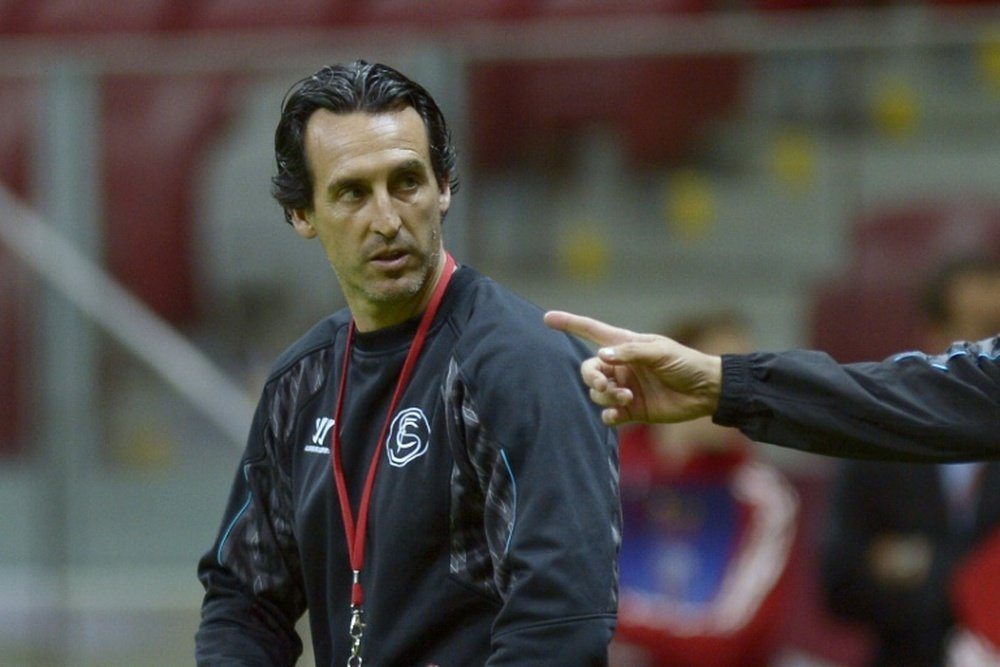
After half a year in what seemed like a failure with Spartak Moscow, Unai Emery returned to La Liga in January 2013 to steady a sinking Sevilla ship. They finished 9th in the league and, by some miracle, qualified for the Europa League third qualifying round.
Barcelona won the league comfortably ahead of Real Madrid, Atletico, and Real Sociedad, but the Madrid teams were finalists in the Copa del Rey, so the 5th, 6th, and 7th teams qualified for the group stage, play-off round, and third qualifying round of the Europa League, respectively.
Malaga, which finished 6th, was excluded from all UEFA club competitions the following season for failing to comply with UEFA Financial Fair Play Regulations.
At the same time, the Spanish FA denied 8th-placed Rayo Vallecano a UEFA license because they didn’t meet the requirements, as they were immersed in a creditor contest. So, 9th-placed Sevilla and Emery took the opportunity, and they used it well.
2013/2014 Season
Sevilla cruised through Europa League qualifying and topped their group, eventually advancing past Maribor into the last 16.
Ghosts of the past appeared in the Round of 16, and it seemed Emery would again be knocked out of the Europa League by a Spanish side when they lost 2-0 at home to Real Betis in the first leg. José Antonio Reyes and Carlos Bacca scored in the second leg to drag the game to penalties, where Sevilla advanced 4-3.
They needed a similar performance against Porto in the quarter-final after a first-leg 1-0 away defeat was overturned by a 4-1 win in the second leg. And like any well-written movie script, Emery’s former side Valencia stood at the stage he’d never passed, hoping to go one step further than he ever took them.
Sevilla won the first leg 2-0 in Seville. But after 69 minutes at the Mestalla, Valencia led 3-0, only for Stéphane Mbia to pull it back with a 94th-minute goal that sent Sevilla through on away goals.
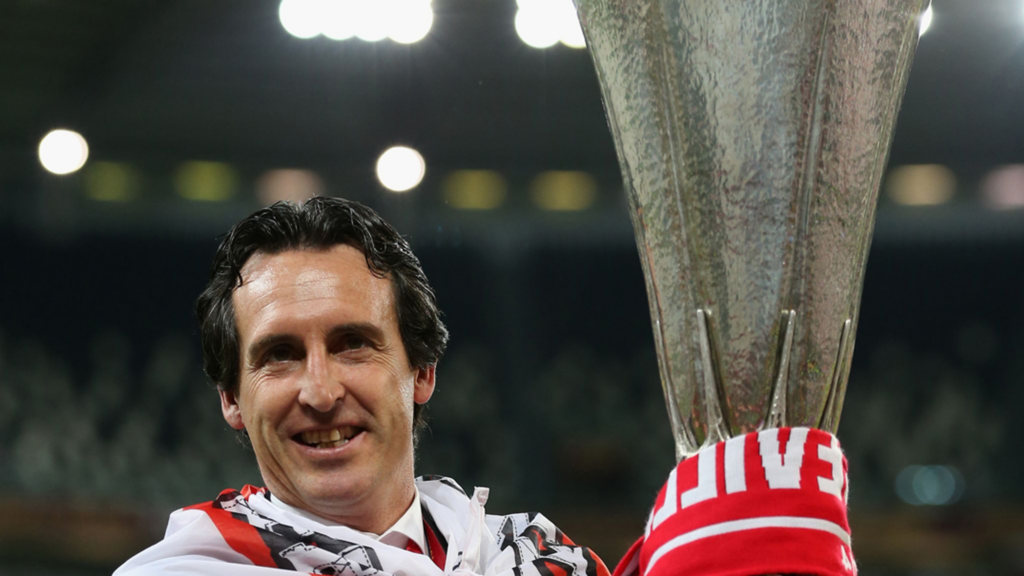
The final against Benfica in Turin was uneventful in terms of goals, and Kevin Gameiro’s kick in the shootout won the Europa League for Unai Emery and Sevilla. This was Emery’s first major trophy; the first of three in a row.
2014/2015 Season
Sevilla returned as defending champions and finished second in Group G behind Feyenoord and ahead of Rijeka and Standard Liege.
They had no such problems in the knockout stages; they beat Borussia Mönchengladbach 4-2 on aggregate, then Villarreal 5-2 on aggregate. A 4-3 aggregate win over Zenit St Petersburg secured another semi-final berth, and they made Fiorentina feel like a polar bear in Texas with a 5-0 aggregate drubbing.
Ukrainian side Dnipro Dnipropetrovsk reached a European final for the first time and took in the moment by going 1-0 up as early as the 7th minute, but Sevilla fought back to win 3-2 and secure a back-to-back Europa League title; a record fourth in history.
Sevilla also became the first team to qualify for the Champions League by winning the Europa League, as UEFA passed the rule at the start of the campaign.
2015/2016 Season
When you win the second-tier trophy back-to-back, people expect you to perform well in the top tier. So when Sevilla were drawn in Group D of the Champions League, alongside Manchester City, Juventus and Borussia Monchengladbach, everyone knew it could be tricky but expected Sevilla to progress to the knockout stages.
However, their performances were nothing to write home about. A 3-0 home win was followed up with four straight defeats in the group. Sevilla finished 3rd in the group on the final day after a 1-0 win over Juventus while Gladbach lost at City.
A chance to defend their Europa League trophy yet again, it offered silverware they might not get elsewhere. A 3-1 aggregate victory over Molde and a 3-0 aggregate win over Basel secured a quarter-final clash against Athletic Bilbao.
Sevilla drew first blood in the tie with a comeback 2-1 win away from home; Bilbao returned the favor in the second, and penalties decided it. Sevilla were perfect from five, but Benat’s miss proved too costly for Bilbao.
There was no such drama in the semi-final as Sevilla got the job done 3-1 at home to Shakhtar Donetsk after the first leg ended 2-2. Gameiro scored three times across both legs and was proving to be the side’s focal point. But a big final against Jurgen Klopp’s Liverpool was, on paper, Sevilla’s toughest test yet in the Europa League.
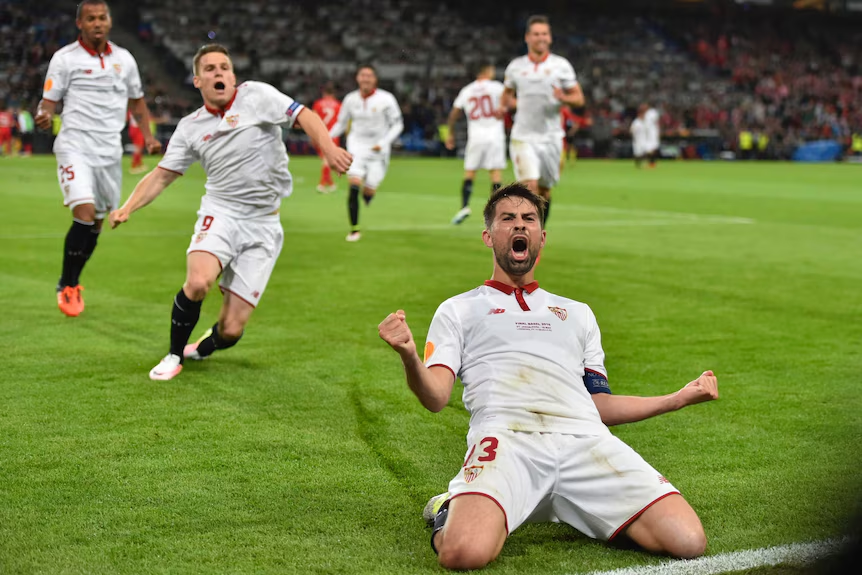
Liverpool had been the story of the Europa League coming into the final. They battled past archrivals Manchester United 3-1 in the Round of 16 before winning an electric 5-4 quarter-final against Borussia Dortmund. They overturned a 1-0 away loss at Villarreal in the semi-final by scoring three unanswered goals in the second leg at Anfield.
Liverpool were favorites, and Daniel Sturridge scored for the Reds within 35 minutes. However, at halftime, Unai Emery told his players to stay calm, trust the game plan, and remember why they reached the final. It worked like a charm.
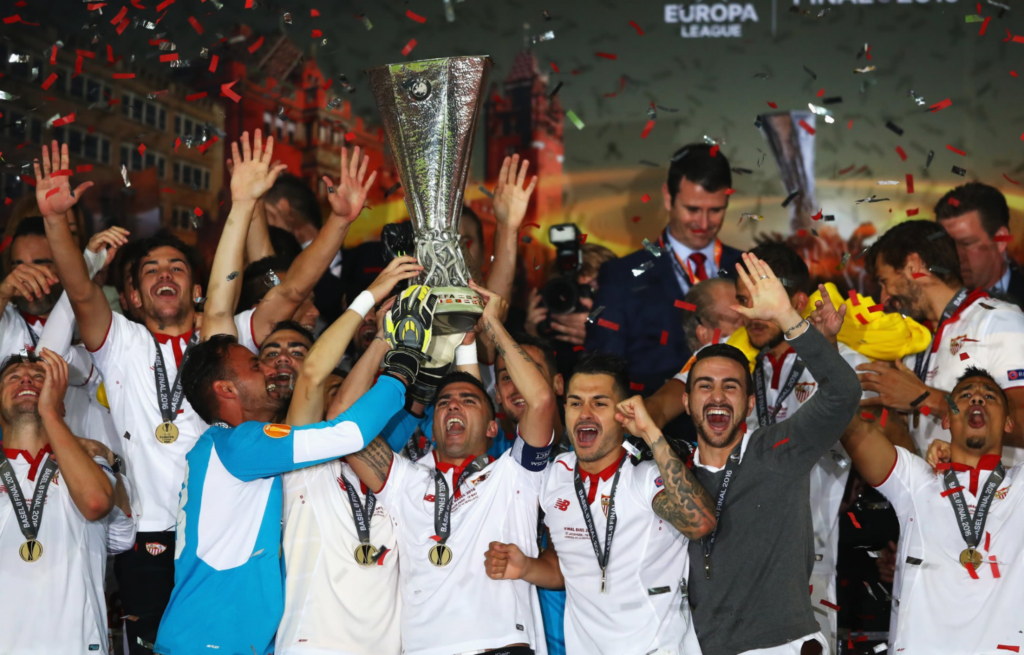
Seconds after the restart, Kevin Gameiro scored his 8th goal of the competition to level the game. A six-minute brace from Coke took the game beyond Liverpool’s reach, and Sevilla claimed a third straight Europa title. Afterward, no one was arguing with Emery when he called it ‘our competition’.
This is a manager who knows how to win trophies, and everyone believed that if given the right resources, he could land the big ones.
So, a month after the final, Emery expressed his desire to leave Sevilla, and succeeded Laurent Blanc at French quadruple-holders Paris Saint-Germain. The aim was simple: continue local dominance and land the crown jewel, the UEFA Champions League.
The Lights Are Too Bright in Paris and London (2016–2019)
Unai Emery spent two seasons at Paris Saint-Germain and, under the club’s high expectations, failed. He lost the Ligue 1 title by eight points to Monaco, but that wasn’t the biggest story. He was on the wrong side of La Remontada. PSG defeated Barcelona 4-0 in the first leg of the Champions League Round of 16, only to lose at the Camp Nou 6-1.
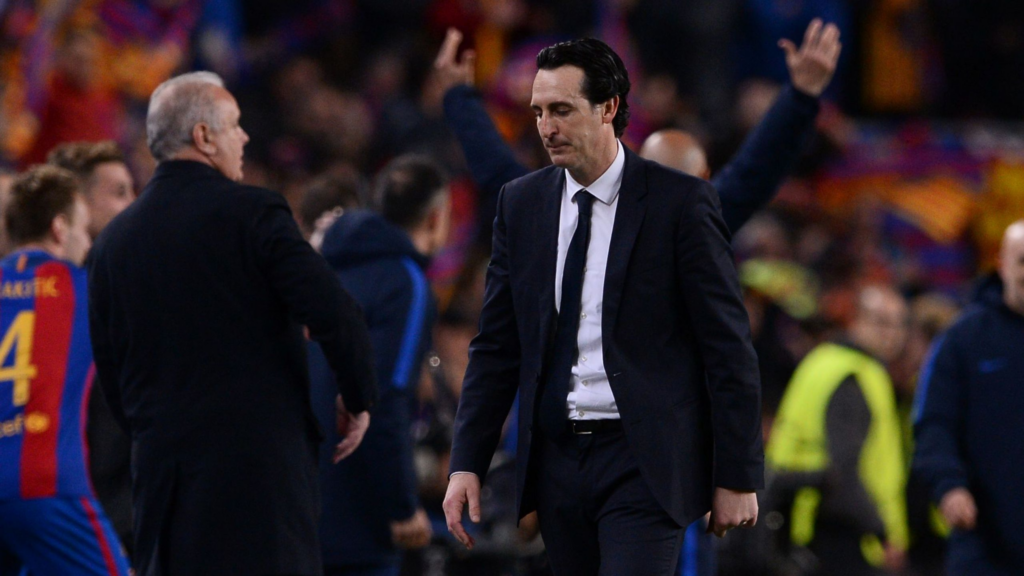
The following season, he won the domestic quadruple: Trophée des Champions, Coupe de la Ligue, Coupe de France, and Ligue 1. But Real Madrid unceremoniously dumped them out of the Champions League in the last 16. Without surprise, he announced he was leaving at the end of the season, a year before his contract ends.
So, when Arsenal came calling at the start of the post-Wenger era, it smelled like a fresh start for both the Gunners and Emery.
Arsenal had qualified for the Europa League, and the reunion was on for Emery to win Arsenal’s first European trophy since 1994.
Emery and Arsenal showed that extra class in the group stage, steaming past Sporting CP, Vorskla Poltava and Qarabag to top the group with 16 points. They overturned first-leg away defeats against BATE Borisov and Rennes with 3-0 home wins in the Round of 32 and last 16.
They faced no such problems in the next two rounds, winning both legs of the quarter-final and semi-final, 3-0 on aggregate against Napoli and 7-3 on aggregate against Emery’s former side Valencia.
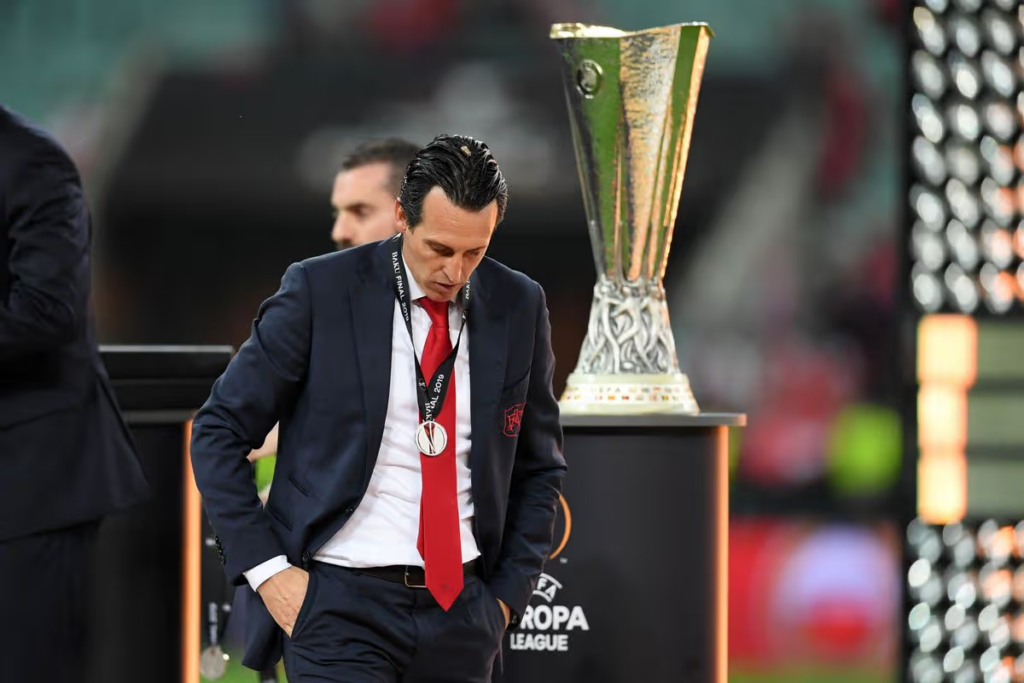
The final pitted Arsenal against city rivals Chelsea in what was the second-ever all-English final and the first contested between clubs from the same city. In a goalless first half, Arsenal were arguably the better side, but everything unraveled in the second half.
Individual mistakes gifted Chelsea two goals, and the Blues ran out 4-1 winners to win their second Europa League trophy, inflicting Emery’s first final loss in the competition.
Arsenal finished fifth in the Premier League that season, missing out on Champions League qualification on the final day after blowing a healthy advantage, and following a poor start to the next season, Emery was gone before the turn of the year.
The Villarreal Redemption (2020–2022)
It didn’t take long for Unai Emery to get another job, and after four years away, he returned to Spain. He signed with Villarreal to succeed Javier Calleja, and this time he made an immediate impact, breaking a club record with 18 unbeaten matches.
In the Europa League, Villarreal finished top of their group with 16 points after running through Maccabi Tel Aviv, Sivasspor and Qarabag. The knockout stage was smooth sailing for the Yellow Submarines, who beat RB Salzburg, Dynamo Kyiv and Dinamo Zagreb in both legs to book a semi-final ticket.
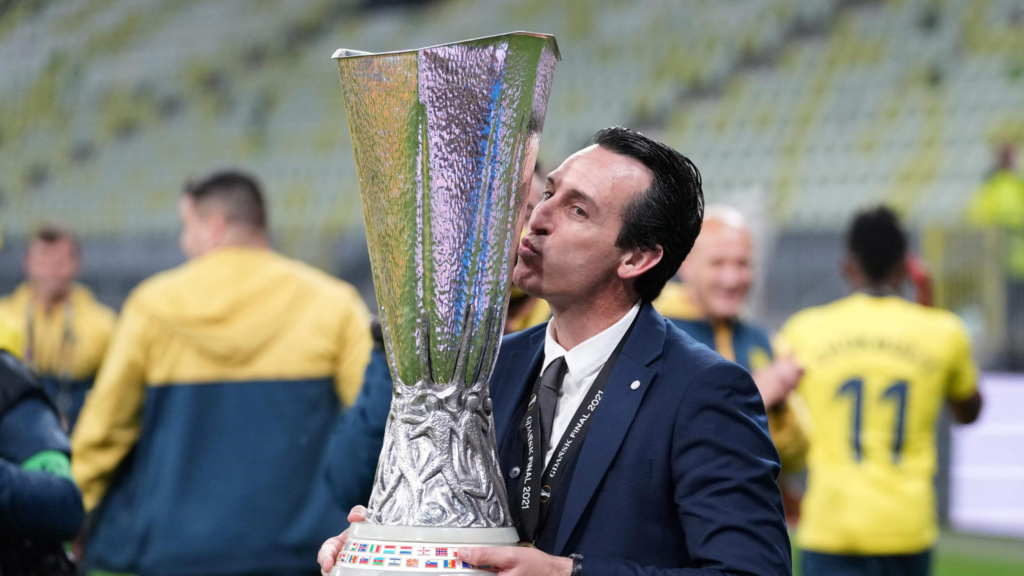
A sense of being hard done by surrounds Emery’s dismissal at Arsenal, and fate gave him a quick chance to get his lick back, as he knocked out the Gunners in the semi-final. A 2-1 home win was followed by a gritty goalless draw at the Emirates, with Emery celebrating with the away fans on the turf of his former employers.
Villarreal lined up against Manchester United in the final; half an hour in, Gerard Moreno scored his 7th goal of the competition to give Villarreal the lead before Edinson Cavani equalized before the hour mark.
The game dragged to penalties, and all 20 outfield players converted from the spot, leaving the goalkeepers to decide. Geronimo Rulli thumped his strike into the top corner and saved David de Gea’s effort in a dramatic shootout.
Unai Emery, yet again, won a Europa League title. It was his fourth, and Villarreal’s first-ever European trophy. It was redemption for the Spanish coach, who completed a feat we’ve all grown to expect. But he wasn’t done.
The Villa Revolution (2022 – Present)
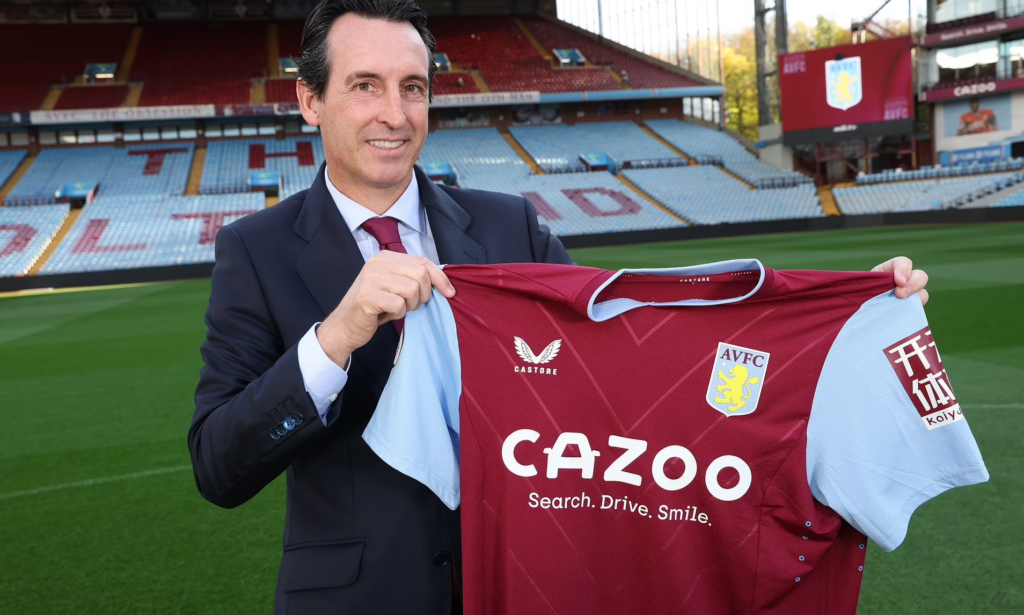
In October 2022, Aston Villa bought Unai Emery out of his Villarreal contract, needing a savior to stop an impending doom. When Steven Gerrard was sacked, Villa had only won 2 games all season and were one point above the relegation zone.
Just like he did with Valencia and Villarreal, Emery hit the ground running and, by the end of the season, dragged Villa to 7th place and the UEFA Conference League. This was Villa’s first European qualification since 2010 and, remarkably, Emery’s 16th consecutive season. It was no fluke.
Emery did not pump the brakes in the 2023/24 season; Emery continued to break club records, such as maintaining a 100% record in Villa’s first eight home games of the season for the first time since the 1932/33 season, and 15 consecutive home league wins, which was the most in the club’s 149-year history. They finished 4th in the league and reached the Conference League semi-finals.
By finishing 4th, Villa qualified for the Champions League for the first time since 1983, and they raised eyebrows with eye-catching performances before being knocked out by eventual champions PSG, another former club.
That season, they missed out on consecutive Champions League qualification on the final day after a 2-0 loss to Manchester United, dropping to the Europa League instead. Sounds like home to Emery.
Whenever the Europa League anthem hits, Emery must be hearing Sia’s Unstoppable because that’s what he becomes in the competition. Villa finished 2nd behind Lyon on goal difference on the League Phase table, and given how well they’ve competed in the Premier League and Champions League in recent seasons, there was an air of optimism and expectation that Villa could win the Europa League. In fact, they were one of the favorites.
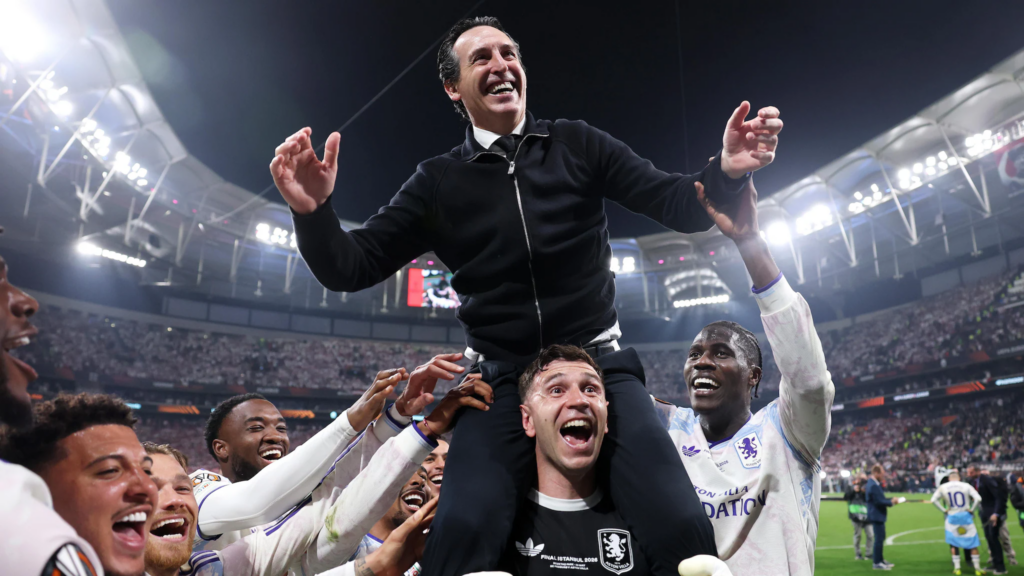
In the knockout stages, Aston Villa swept Lille (3-0 on aggregate) and Bologna (7-1 on aggregate) to reach an all-English semi-final against Nottingham Forest. They lost the first leg 1-0 away, but four unanswered goals in the second leg, in front of their home fans, booked their ticket to Istanbul.
In the final against SC Freiburg, Villa were essentially crowned champions after 60 minutes. Youri Tielemans and Emiliano Buendia struck before half-time, and in the 58th minute, Morgan Rogers scored the third to get the party started.
If there was any argument about who the greatest Europa League manager is, it died in Turkey that night. Six finals and five wins, basically mirroring Carlo Ancelotti and the UEFA Champions League.
If you think about it, Emery succeeded in this competition by design. Look at his league form in every season he reached the final, and you’ll notice a similar trend. His team picks up a lot of wins and points till March/April, and then you see more dropped points and losses. This was the business end of the season, but Emery’s teams were never vying for the league titles. They simply chose to go after titles that meant more than 5th- or 6th-place finishes.
His only domestic trophies came during his time at PSG, and those are expected when you’re the manager of the Paris club. Arsenal fans will argue that Mikel Arteta is a better manager than Emery, and until the recent divorce, Chelsea fans would argue the same in support of Enzo Maresca.
The argument should not be about whether he is better than another manager; in his stratosphere, he is the best. So, the question is, how many more Europa titles will he win?
Who wrote this?

Philip is a sports broadcaster at Royal FM 95.1 in Ilorin, Nigeria, where he presents Sport File and Soccer Chat. Away from the mic, he writes long-form football pieces and runs Football Chronicles on YouTube. He has worked with AFTV, Kwara Youth League and Koller FA. He's interested in the stories behind the results — why teams rise, why they fall, and what gets forgotten in between.