




There is a particular kind of silence that falls over the stadium seconds before a world record is broken. No one sees it coming.
And in Eugene, Oregon, it didn’t seem like the audience really knew what they were looking at. It was the semi-final of the women’s 100m hurdles. On the track were nine women. One of them is Kandra Harrison, 2016 Women’s 100m hurdles champion and world record holder at 12.20 seconds.
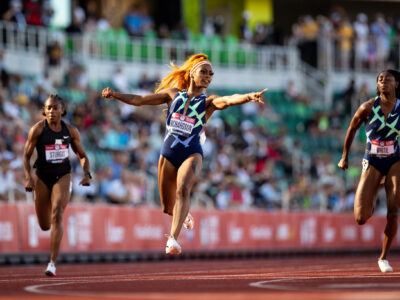
Two tracks away from her was another young woman from Ijebu Ode, Ogun State – Tobi Amusan. The starter fires the shot. What happens next lasts 12.12 seconds. The fastest any woman has ever run the 100 metres hurdles in the history of human civilisation. Amusan crosses the line, and the stadium erupts.

But that’s not all. While the papers and world athletics bodies attempt to comprehend what had just unfolded right before their eyes, Amusan returns to the tracks later and wins gold, breaking her own record less than two hours later.
And in between the chaos is a truth that Nigeria has not yet fully reckoned with: that Amusan’s record and this moment of glory were built almost entirely without her country’s help.
Nigeria celebrated. The system that failed her celebrated loudest of all.
A Football Country, and the Cost of That Gospel

To understand Nigerian athletics, you must first understand what Nigeria has decided it is. For a significant period of Nigeria’s sporting history, football has been at the epicentre of every sporting activity.
From the streets to every viewing centre–mostly stacked on Premier League weekends, down to the unmatched ambience of stadiums during national games—Nigeria is a football country.
This is not inherently a problem. Football is the world’s game, and Nigeria has produced a handful of players who have illuminated scenes in Europe over time. How could one forget Jay-Jay Okocha’s threading passes that seemed to bend the laws of physics? Or the image of Rashidi Yekini gripping the net when he scored Nigeria’s first-ever World Cup goal in 1994? Or Ademola Lookman’s sublime hat-trick against Bayer Leverkusen in the 2024 Europa League final?

Sadly, there is an awful lot that governing bodies, such as the National Sports Commission, get wrong, especially when it comes to the position of non-football sports in the country. Every naira that flows into football is a naira that does not flow into the dozens of other disciplines where Nigerians compete. And often, despite everything, win.
Four years ago, Tobi Amusan put Nigeria on the global radar of athletics. Twice. A feat that, for a moment, showed what Nigeria could be if it looked beyond the football pitch. And that is by no means the perfect mechanism for building a pipeline.
Conversely, the National Sports Commission’s budget allocation has always been finite, and so is infrastructure. And when a country decides that one sport is the only sport worth investing in, everything else begins to starve.
The cruellest irony is that football itself is now starving.
Despite Africa gaining nine World Cup spots in 2026, Nigeria missed out for the second time in eight years. A country of over 220 million people, with one of the deepest talent pools on the continent.
More so, the events before qualifying exposed deep dysfunction and rot within the Nigerian Football Federation. Just two days before a critical playoff semifinal against Gabon, the Super Eagles players went on strike over unpaid allowances.
This is exactly what happens when you centralise all your resources, attention, and expectations around one sport, and then fail to manage even that one properly.
Cones, Tyres, and a Scholarship to Somewhere Else

The concept of “competitive hurdles” does not exist in Ijebu Ode.
Let that sentence sit for a moment. Nigeria’s first-ever world athletics champion grew up in a town where the basic equipment of her discipline did not exist.
So Tobi Amusan trained with cones and tyres. She improvised her way to excellence because the system meant to nurture her never showed up and had no plans to.
What eventually unlocked her potential was not the Athletics Federation of Nigeria. Rather, it was a scholarship to the University of Texas at El Paso. In other words, an American university, with American facilities, American coaching, and American investment in her development, is what gave Nigeria its world champion.
The irony of how Amusan’s rise came to be mirrors the larger Nigerian society, transferring talented young athletes to European/ American academies is akin to the exportation of crude oil and importation of its refined products without making investments in oil refineries.
It is a cycle that flatters the system while indicting it.
The Bleed

There is an old Yoruba proverb: Ile ni ajo, orun ni ile – the earth is a journey, heaven is home. Nigerian athletes have been finding their own version of home elsewhere for decades now. Nigeria’s sports industry has watched them go with the resignation of an institution that has never truly understood what it is losing, but with an overarching confidence that another wave of athletes will replace those who leave.
Francis Obikwelu left Nigeria for Portugal and became a dual world-record holder at 100 and 200 metres. Florence Ekpo-Umoh chose Germany. Annette Echikunwoke, who could have been one of Nigeria’s hammer throw greats, now competes for the United States.

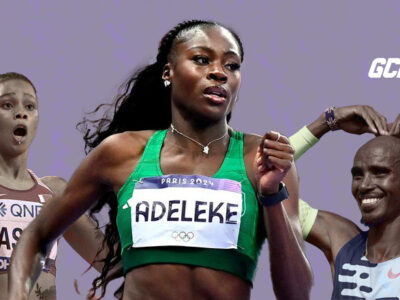
And most recently, Favour Ofili, a 4 time Olympian, made the pragmatic decision to transfer her allegiance to Turkey. Athletes cited the same grievances pushing them to the breaking point: administrative failures, unpaid allowances, and institutional indifference.
Even the AFN president, to his credit, has publicly acknowledged the danger. Tonobok Okowa, ahead of the 2025 World Athletics Championship, revealed that many of Nigeria’s elite athletes are being approached by foreign countries with significant financial offers to change their nationality and allegiance.
“I can tell you that most of our elite athletes are already being approached by other countries to change their nationality and allegiance,” he said.
The tragedy in this trope is not just that Nigeria loses these athletes. It is that Nigeria has the talent and resources needed to dominate at the highest level, but priorities lie elsewhere.
As of 2026, the NSC national budget ballooned by nearly 80 per cent, from ₦113 billion to ₦203.6 billion. Yet the single highest expenditure on the approved list is pegged at ₦49.1 billion for anniversaries and celebrations: 24.1 per cent of the entire budget, and a figure that dwarfs the 1.1 per cent set aside for football development in Nigeria.
Now, if the primary sport that receives the majority of attention and focus receives such, what chance does athletics stand?
The Generation That Refused to Wait
Right in the middle of this dysfunction, there is an emergence of a new generation of Nigerian track and field athletes producing performances that demand attention.
At the 2025 World Athletics Championships in Tokyo, 18-year-old Israel Okon ran a heat in a blistering 9.97 seconds, defeating the reigning Olympic 100-metre champion, Lamont Jacobs, in the process. In the same championship, Ezekiel Nathaniel shattered the national 400 metres hurdles record with a scorching 47.11 seconds.

Similarly, Miracle Ezechukwu won gold at the African Youth Championship in Algeria. Prestina Ochonogor made the 2024 Paris Olympic long jump final, placing her among the world’s best in her event.

Also, Chukwuebuka Enekwechi, born in the United States, has repeatedly chosen the green and white and consistently produced Nigeria’s best-ever shot put performances on the global stage. And there’s Rosemary Nwankwo, who clinched gold at the 2025 African School Games and will be representing Nigeria at the 2026 World Relay in Gaborone, Botswana.
What strikes most about this generation of athletes is not their talent but their resolve towards the system. Many of them watched Amusan win despite the system, and Ofili leave because of it. They have inherited a rather complicated legacy, and they are sprinting toward it anyway. The big question is whether Nigeria will meet them halfway.
The Money That Exists

Nigeria’s sports budget increased by 227% in 2025. The National Institute of Sports’ 2026 budget proposal grew from ₦2.8 billion to ₦60 billion. Also, the Nigerian Sports Commission recently distributed ₦200 million in training grants to 26 athletes ahead of the 2026 Commonwealth Games, and the NSC’s Youth Appreciation Tour awarded cash prizes to five standout young athletes, totalling ₦11 million. These are not trivial figures.
The money exists. The real problems are poor prioritisation and the lack of a long-term development philosophy that Nigerian sports desperately need.
Structural signals are present. The NSC’s Elite and Podium Board represents an attempt to identify and invest in medal-viable athletes. The Invited Junior Athletes policy acknowledges the importance of youth development, and President Tinubu’s unified sports funding directive suggests, at least in intention, a more coordinated approach to resource allocation.
But signals are not systems. As of early 2026, the NSC has started mobilising contractors to renovate Abuja’s long-overdue Moshood Abiola National Stadium. It is a headline project. But what it does not do is put a hurdle in front of a fourteen-year-old in Ijebu Ode.
There has been no announced framework for school sports revival yet, no identified grassroots talent identification programme, and no funded coaching pathway for the domestically-based athletes who lack the option of an American scholarship.
What a Real Pipeline Looks Like

Jamaica has a population of under three million people. It is a small island with modest resources and significant socioeconomic challenges. It is also the most dominant sprinting nation on earth, and has been for the better part of two decades.
This did not happen by accident. The recurrent dominance is a result of a deliberate, sustained decision by the Jamaica Athletics Administrative Association to invest in grassroots athletics.
The ISSA Boys and Girls Championships, which has been held annually since 1910, is a talent identification mechanism that has produced a crop of fine talent, including Usain Bolt and Shelly-Ann Fraser-Pryce, and recently Oblique Seville, 100m champion at the 2025 World Athletics Championship.

No country is uniquely blessed with people with unique genetic or physiological characteristics. It starts with access and a system that finds athletes early, develops them, and stops them from falling through the cracks.
Kenya and Ethiopia offer similar examples. Both nations, despite significant resource constraints, have produced some of the world’s long-distance champions.
And Nigeria, with 220 million people, a growing sports budget, and a demonstrable reservoir of athletic talent, has no credible excuse for allowing its school sports system to collapse. The inception of the 1984 Principals’ Cup competition served as the early proving grounds for generations of Nigerian athletes and a pipeline for Nigeria’s development of its young talents.
While football-specific, it reflected a philosophy: schools are the first stadium, and students the first athletes worth celebrating. This was a template Nigeria could have extended to every sport on the calendar.
The Record and the Road

Tobi Amusan grew up in the streets of Ijebu Ode with no hurdles and a dream that the system around her was not designed to accommodate. She made her own hurdles from whatever was available; she cleared them until she was clearing them faster than any woman ever had.
Amusan’s story is remarkable, but it’s in itself an indictment.
Tobi Amusan succeeded with cones, tyres, and foreign scholarships. With a proper track and federation, she could’ve done it at home.
What could Israel Okon become with the institutional scaffolding Italy has built around Lamont Jacobs? What might Favour Ofili have built, in green and white, had building in green and white ever been a genuinely viable option?
The talent still exists. What remains is the administrative will to build a working system that sets its priorities right. Nigerian sports must see athletics development as a long, unglamorous act of showing up for youth before they’re known.
Nigeria has enough talent to fill a dozen Tobi Amusans.
The only question left: the one this country has been deferring for far too long, is whether it has enough seriousness to keep them.
Who wrote this?

Mahbubat Salahudeen is a Sport Journalist with a primary focus on Youth-Athleticism and women's football.
She is currently pursuing a degree in Media Communications and Public Relations. While much of her experience lies in Sports communications, she has honed transferable skills in strategic communication, audience engagement, and digital media production that transcend industries.
- Mahbubat Salahudeen

- Mahbubat Salahudeen

- Mahbubat Salahudeen

- Mahbubat Salahudeen

- Mahbubat Salahudeen

- Mahbubat Salahudeen

- Mahbubat Salahudeen

- Mahbubat Salahudeen

- Mahbubat Salahudeen

- Mahbubat Salahudeen